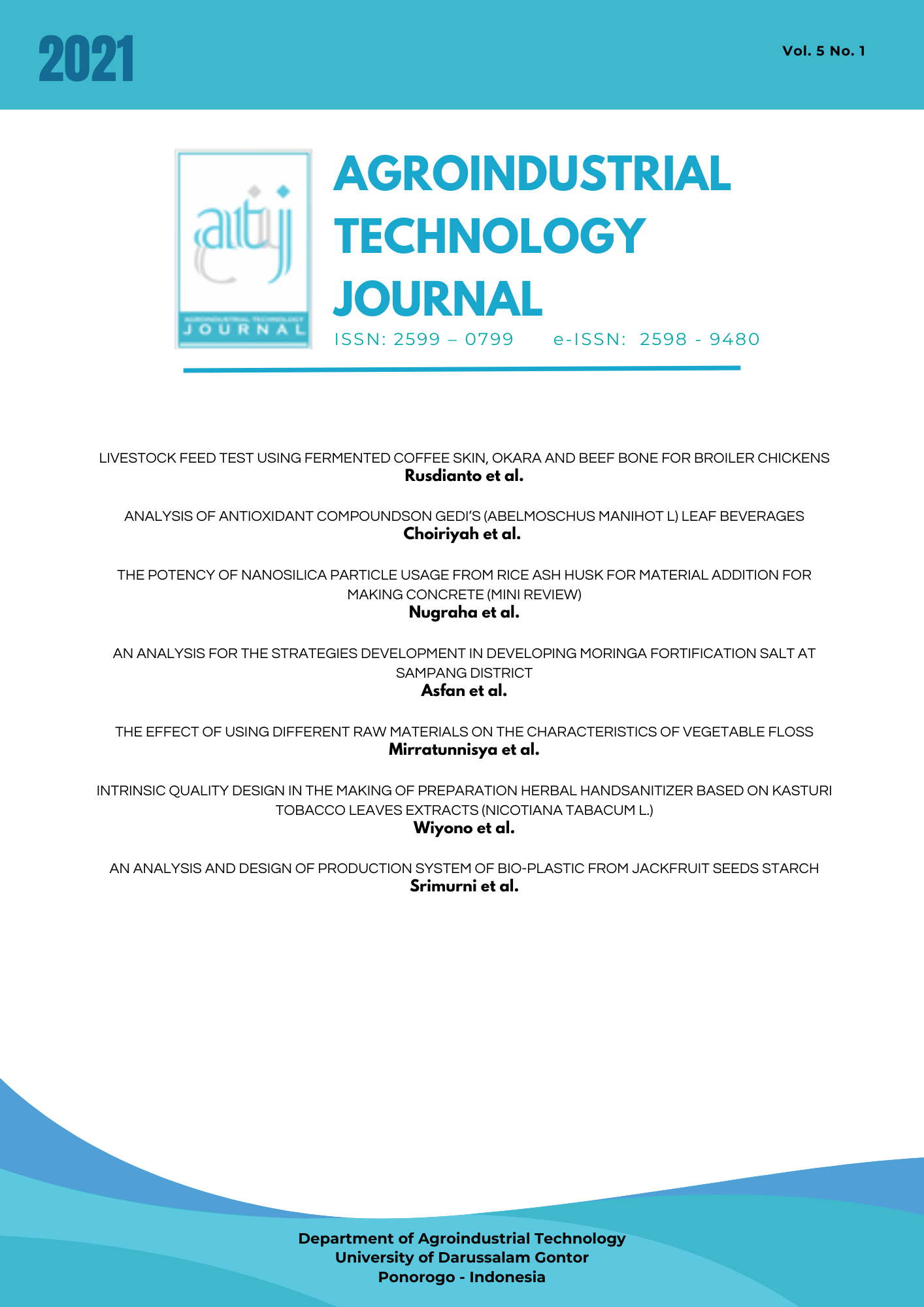
The Effect of Using Different Raw Materials on the Characteristics of Vegetable Floss
Keywords:
breadfruit, floss, jackfruit, kluwihAbstract
Flossis a food that is generally made from meat, but flosscan also be developed from local food ingredients that have fiber-like meat such as kluwih, breadfruit,and jackfruit. Making floss from local food can increase food diversification and its economicvalue. The purpose of this study was to determine the sensory and chemical characteristics of artificial flosses fromkluwih, breadfruit,and jackfruit. Thisresearch used a completely randomized design with 3 typesof the raw materials:kluwih, breadfruit,and jackfruit. The result of the water content test showed an average value of 3.47-3.65%. The results should that the floss from kluwih tended to be preferred by the panelists. The treatment of the use of different types of materials showed significantly different effects on moisture content, hedonicvalueand color ofthe vegetable floss
References
Aida, Y,ChF Mamuaja, AT Agustin. 2014. Pemanfaatan Jantung Pisang (Musa paradisiacal) dengan Penambahan Daging Ikan Layang (Decapterus sp) Pada Pembuatan Abon. Jurnal Ilmu dan Teknologi Pangan. Vol. 2. No. 1, hal 20 –26AOAC. 2005. Official methods of analysis. AOAC (Association of Official Analytical Chemists) International. Washington DC : Association of Official Analytical Chemists.Astuti, F., Agustin, K. 2016. Pengaruh Lama Fermentasi Kecap Ampas Tahu terhadap Kualitas Fisik, Kimia dan Organoleptik. Jurnal Pangan dan Agroindustri4 (1):72-93Badan Standrisasi Nasional. 1995. Standar Nasional Indonesia.SNI-01-3707-1995.Abon. BadanStandarisasi Nasional.Jakarta.Buckle, K.A, R.A Edwards, G.H. Fleet, and M. Wootton. 2009. Ilmu Pangan ( Food Science ). Jakarta: Penerbit Universitas Indonesia (UI-Press).Fadzilla, F. 2018. Pemanfaatan jantung pisang dan kluwih pada pembuatan abon ikantongkol (Euthynnus affinis) ditinjau dari analisis proksimat, dan uji asam tiobarbiturat (TBA).Jurnal Teknologi Pangan,12(1), 60-66.Fathurahman, E. 2008. Penanganan Daging Sapi. Food Review. Retrieved November, 2, 2012.Hardoko, H., Sari, P. Y., & Puspitasari, Y. E. 2015. Subtitusi jantung pisang dalam pembuatan abon dari pindang ikan tongkol.Jurnal Perikanan dan Kelautan,20(1), 1-10.Hastanto. 2015. Analisis Kelayakan Pengembangan Agroindustri Abon Jantung Pisang (Musa acuminata balbisiana colla.) dengan Penambahan Keluwih (Artocarpus camansi).Skripsi Fakultas Teknologi Pertanian, Teknologi Hasil Pertanian, Universitas Jember.Hutching, J.B. 1999. Food Color and Appearance. Aspen publisher, Gaitherburg Maryland.Indiarto, R., Nurhadi, B., Subroto, E. 2012. Kajian Karakteristik Tekstur (Texture Profil Analysis) dan Organoleptik Daging Ayam Asap Berbasis Teknologi Asap Cair Tempurung Kelapa. Jurnal Teknologi Hasil Pertanian 5(2): 106-116Indriyani, N dan Ihsan, F. 2015. Mengenal Nangka dan Kerabatnya. Iptek Hortikultura No 11: 47-50
Jannah, U., Q., A.,N., Darimiyya H., Abdul A., J. 2016. Karakteristik Sensoris dan Kimia Pada Abon Nangka Muda (Artocarpus heterophyllusLMK) dengan Penambahan Tempe. Jurnal Agrointek Volume 10, No. 1Rohmawati, N. 2016. Pengaruh Penambahan Sukun Muda (Artocarpus communis) Terhadap Mutu Fisik,Kadar Protein, dan Kadar Air Abon Lele Dumbo (Clarias gariepinus). Jurnal Nutrisia, Vol. 18 Nomor 1, hlm 65-69Sinaga, A. 2019. Segmentasi Ruang Warna L*a*b. Jurnal Mantik Penusa3(1):43-46Syarief dan Habid. 2010. Kadar Air Abon Ikan. Institut Pertanian Bogor. Bogor.Tsaniyatul, Siti. 2013. Pengaruh Suhu Pengukusan Terhadap Kandungan Kandungan kimia dan Organoleptik Abon Ikan Gabus (Ophiocephalus striatus). THPi Student Journal, Vol. I No. 1Wahyuni, T., H., Joharnomi, R dan Prissa, N., S. 2015. Perbandingan Antara Substitusi Keluih (Artocarpus Communis) dan sukun (Artocarpus Altilis) Terhadap Kualitas Abon Sapi. Jurnal Agribisnis Peternakan, Vol.1, No.2.Zaroroh, F., A. 2013. Eksperimen Pembuatan Abon Keong Sawah Dengan Substitusi Kluwih Dan Penggunaan Gula Yang Berbeda. Food Science And Culinary Education Journal2
Downloads
Submitted
Published
How to Cite
Issue
Section
License
Copyright (c) 2021 The Author (s)

This work is licensed under a Creative Commons Attribution-NonCommercial-ShareAlike 4.0 International License.
The author whose published manuscript approved the following provisions:
1. The right of publication of all material published in the journal / published in the Agroindustrial Technology Journal is held by the editorial board with the knowledge of the author (moral rights remain the author of the script).
2. The formal legal provisions for access to digital articles of this electronic journal are subject to the terms of the Creative Commons Attribution-NonCommercial-ShareAlike 4.0 International License (CC BY-NC-SA 4.0), which means that Agroindustrial Technology Journal reserves the right to save, transmit media or format, Database), maintain, and publish articles without requesting permission from the Author as long as it keeps the Author's name as the owner of Copyright.
3. Printed and electronically published manuscripts are open access for educational, research and library purposes. In addition to these objectives, the editorial board shall not be liable for violations of copyright law.