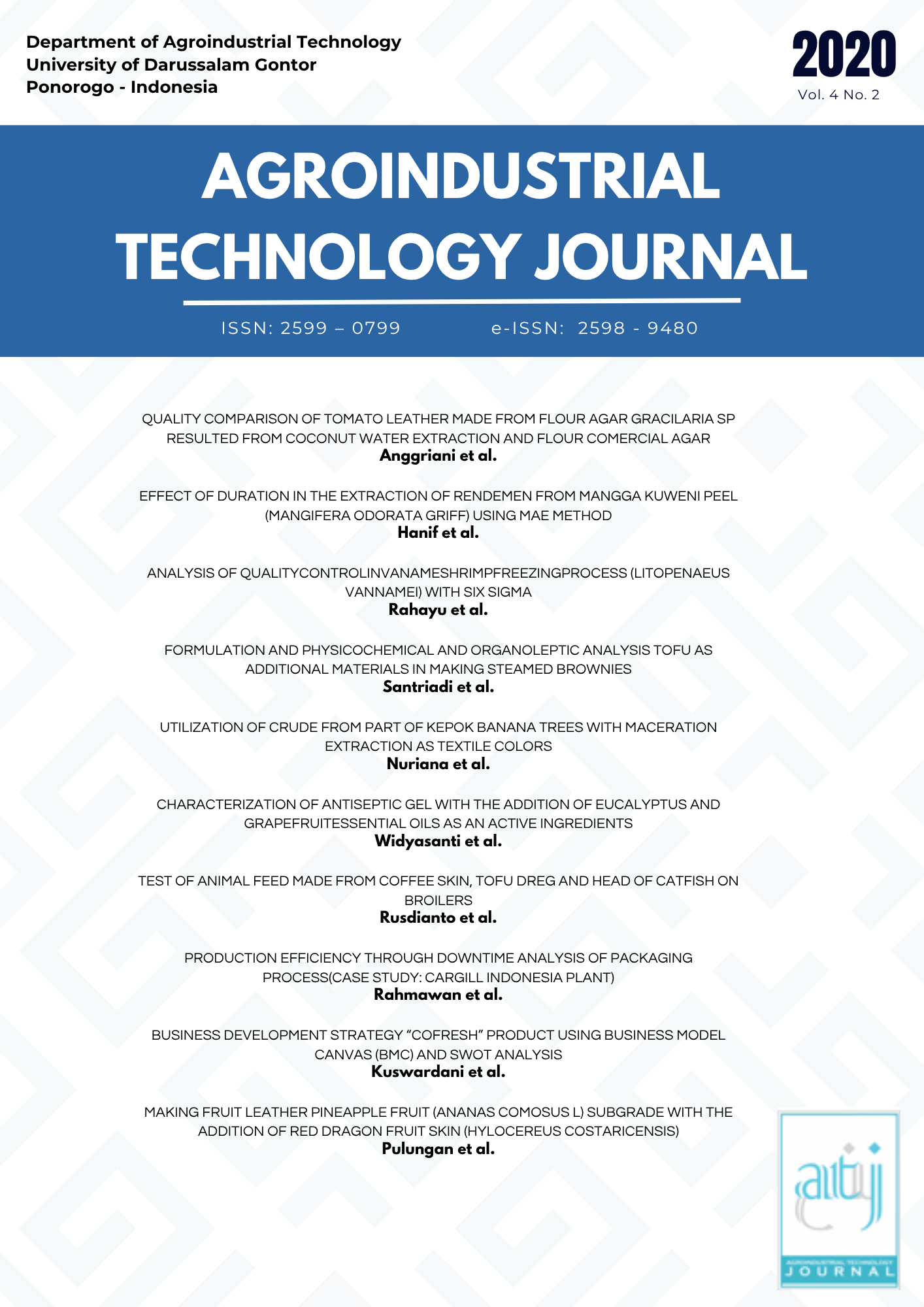
Formulation and physicochemical and organoleptic analysis tofu as additional materials in making steamed brownies
Keywords:
Brownies, Tofu, SteamedAbstract
Tofu is asoft solidfoodmaterial madefrom soybeans and rich in protein. So tofu can be applied as an additional ingredient in making steamed brownies. The purpose of this study was to obtain a formulation of steamed brownies with the addition of tofu which was accepted by panelists. In addition, this study also aims to determine the effect of tofu on the chemical and physical properties of steamed brownies. This study uses preliminary research with an experimental method of making brownies with the addition of tofu which is divided into 3 different samples based on the number of tofu additions namely 37.5gr, 75gr and 112.5gr and further research is organoleptic, chemical and physical tests. The experimental design in this study was a completely randomized design (CRD) with 2 replications of samples and 2 replications of analysis. The results of the organoleptic test showed that steamed brownies with the addition of the most dominant tofu was F1 with the addition of tofu 37.5 gr byassessing the attributes of taste (6.3%), color (6.1%), texture (6.3%) and aroma (5, 5%). Physical tests show that more tofu additions can affect the development ratio and specific volume of the dough. F1 steamed brownies contain water (36.16%), total sugar (35.32%), protein (0.20%). Steamed Brownies F2 contain water (36.84%), total sugar (23.55%), protein (0.30%). While the F3 steamed brownies contain water (39.50%), total sugar (6.81%), protein (0.33%).The steamed brownies with the addition of tofu werethe most preferred by panelists through testing the attributes of aroma, color, texture and taste, namely F1 with the addition of tofu 10% or as much as 37.5 grams
References
AOAC. 1995. Official Methods of Analysis of the Association Analytical Chemist. Inc., Washington D.CAstawan, M. (2009). Panduan Karbohidrat Terlengkap. Jakarta : Dian RakyatHermawan Seftiono,2016.‘Perubahan Sifat Fisiko Kimia Protein Selama Proses Pembuatan Tahu Sebagai Rujukan Bagi Posdaya’, Jurnal Kesejahteraan Sosial, 85-92Hestiawan, M. S. (2013). Pengembangan Produk Tahu Berkalsium Tinggi Dalam Skala Pilot Plan Di Technopark Fateta-IPB. Journal of Chemical Information and Modeling, 53(9), 1689–1699. IndahMega Astuti dan Ninik Rustanti, 2014.Kadar Protein, Gula Total, Total Padatan, Viskositas Dan Nilai Ph Es Krim Yang Disubstitusi Inulin Umbi Gembili (Dioscorea Esculenta). Journal of Nutrition collage. Vol 3. Kim JC dan Ruiter D. 1968. Bread from Non-Wheat Flours . Food Technol 22: 867--878.Lestari, Dewi Puji,2010. ‘Karakterisasi Fisikokimia Tepung Sorgum Fermentasi Dan Aplikasinya Sebagai Bahan Substitusi Roti Tawar’, 1–76Maysuci Ayunir, Ansharullah, Hermanto. Pengaruh Substitusi Tepung Ampas Tahu Terhadap Komposisi Kimia Dan Organoleptik Roti Manis. Jurnal Sains dan Teknologi Pangan. Vol 2. 2017Murray, J. M., C. M. Delahunty dan I. A. Baxter. 2001. Descriptive sensory analysis: past, present, and future.Journal. Food Research International, 34: 461-471.Nurul K, Kadirman, dan Ratnawaty F, ‘Studi Pembuatan Nugget Berbahan Dasar Tahu Dengan Tambahan Sayuran’, Jurnal Pendidikan Teknologi Pertanian Volume 4, 2018Rusdin Rauf dan Khasanah T.A, Sifat Fisik dan Penerimaan Roti Tawar dari Tepung Komposit Terigu dan Singkong dengan Variasi Lama Pencampuran Adonan, Jurnal Agritech vol. 39, 2019
Downloads
Submitted
Published
How to Cite
Issue
Section
License
Copyright (c) 2020 The Author (s)

This work is licensed under a Creative Commons Attribution-NonCommercial-ShareAlike 4.0 International License.
The author whose published manuscript approved the following provisions:
1. The right of publication of all material published in the journal / published in the Agroindustrial Technology Journal is held by the editorial board with the knowledge of the author (moral rights remain the author of the script).
2. The formal legal provisions for access to digital articles of this electronic journal are subject to the terms of the Creative Commons Attribution-NonCommercial-ShareAlike 4.0 International License (CC BY-NC-SA 4.0), which means that Agroindustrial Technology Journal reserves the right to save, transmit media or format, Database), maintain, and publish articles without requesting permission from the Author as long as it keeps the Author's name as the owner of Copyright.
3. Printed and electronically published manuscripts are open access for educational, research and library purposes. In addition to these objectives, the editorial board shall not be liable for violations of copyright law.