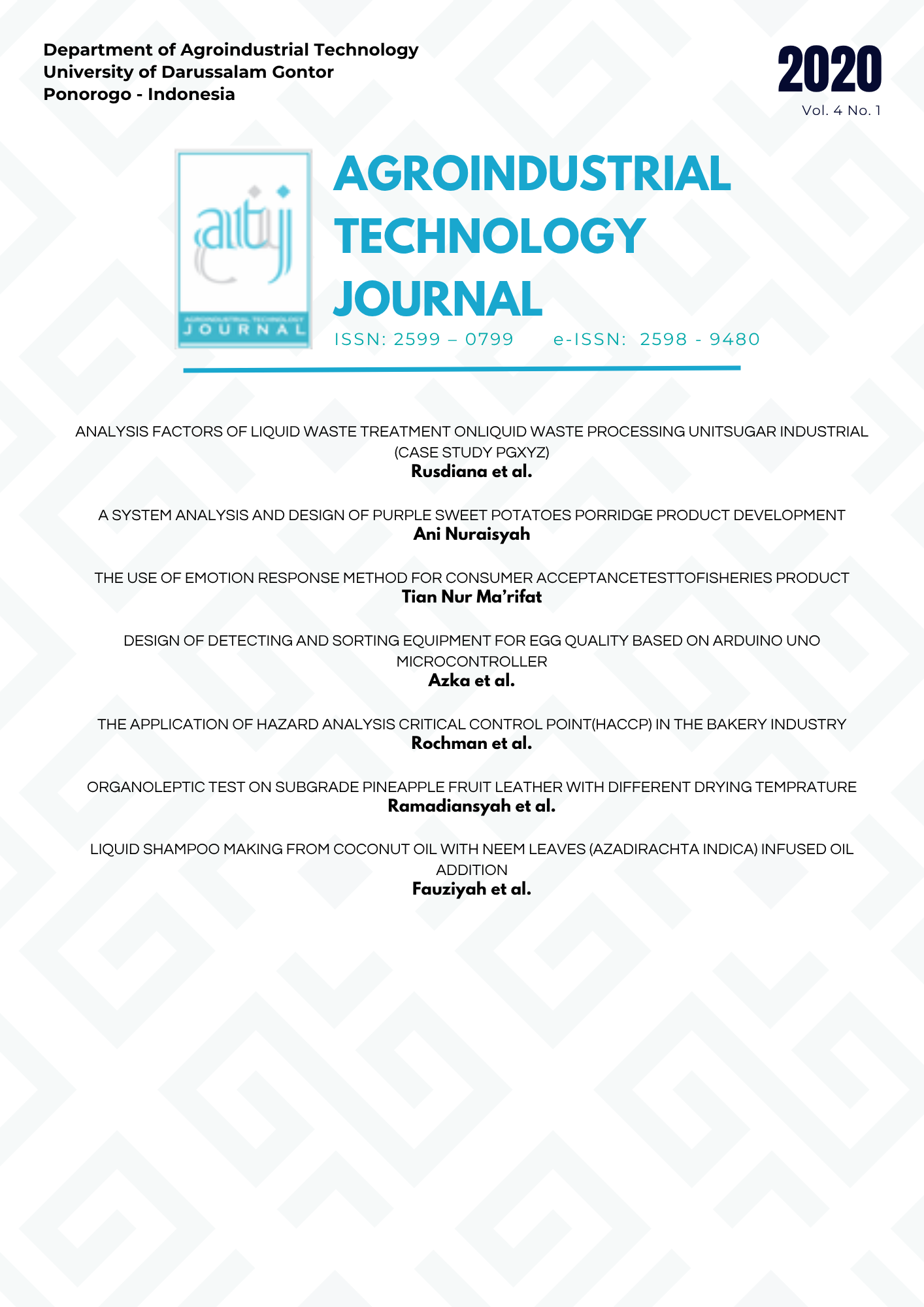
Organoleptic Test on Subgrade Pineapple Fruit Leather with Different Drying Temprature
Keywords:
Fruit Leather, Carrageenan, Sorbitol, OrganolepticAbstract
Fruits are agricultural commodities that have high economic value. Pineapple is one of Indonesia's superior tropical fruit. Pineapple can be processed into various products such as juice, sweets, and fruit leather. Fruit leather is a kind of dried candy that can be used as a form of commercial processing on an industrial scale, shaped like a thin sheet of paper with a thickness of 2mm -3mm. Fruit leather is made from fruit flesh that has been crushed and dried. The purpose of this study was to determine the organoleptic test of 3 differences in drying temperature (60ºC, 70ºC, 80ºC) which included the aroma, taste, texture and color of the subgrade pineapple fruit leather. This study uses a completely randomized design (CRD) method. Data analysis was performed using the one-way Analysis of Variant or (ANOVA) method of analysis with Duncan's further tests. Subgrade pineapple leather with differentdrying temperature treatment that is 60ºC, 70ºC, 80ºC produces different fruit leather. The final result on fruit leather with a drying temperature of 60ºC looks smooth and not too dry. As for the temperature of 70ºC the surface texture looks a bit rough but still good. The temperature of 80ºC has a rough texture and feels dry. The highest yield was found at the treatment temperature of 60 ° C with a final value of 99.2% of the material, and the lowest value was found at the treatment temperature of 80 ° Cwith the final value of the material 98.2%. Based on the results of this study, the best treatment was obtained at a temperature of 60ºC subgrade pineapple puree. The temperature of 60 ° C in the organoleptic test is characteristic of light brown color and is preferred, the texture is chewy and somewhat preferred, the aroma and taste are preferred, and are the products most favored by panelists
References
BSN, D. (2013). Kajianpengawetan manisan kering buah nenas (ananas comosus l. Merr) selama masa penyimpanan. Jurnal Agroindustri, 78.Hasibuan , R. O. (2005). proses pengeringan . Usu Repository, 1.Kurniawan , D. (2014). Analisis pengeringan pada proses pembuatan lembaran buah (Fruit Leather) pepaya. Intitut Pertanian Bogor, 14-15.Marzelly, A. D., Yuwanti, S., & Lindriati, T. (2017). Karakteristik fisik, kimia sensoris fruit leater pisang ambon (musa paradisiaa s.) Dengan penambahan gula dan karagenan. Jurnal Agroteknologi , 4.J. K. Negara, A. K. Sio, Rifkhan, M. Arifin, A. Y. Oktaviana, R. R. S. Wihansah, M. Yusuf,” Aspek Mikrobiologis Serta Sensori (Rasa, Warna, Tekstur, Aroma) Pada Dua Bentuk Penyajian Keju Yang Berbeda”, Jurnal Ilmu Produksi dan Teknologi Hasil Peternakan, Vol. 04 No. 2 Juni 2016.Tri Astuti, Esti Widowati, Windi Atmaka,” kajian karakteristik sensoris, fisik, dan kimia fruit leather pisang tanduk (musa corniculata lour.) Dengan penambahan berbagai konsentrasi gum arab”, Jurnal Teknologi Hasil Pertanian, Vol. 8, No. 1, Februari 2015
Downloads
Submitted
Published
How to Cite
Issue
Section
License
Copyright (c) 2020 The Author (s)

This work is licensed under a Creative Commons Attribution-NonCommercial-ShareAlike 4.0 International License.
The author whose published manuscript approved the following provisions:
1. The right of publication of all material published in the journal / published in the Agroindustrial Technology Journal is held by the editorial board with the knowledge of the author (moral rights remain the author of the script).
2. The formal legal provisions for access to digital articles of this electronic journal are subject to the terms of the Creative Commons Attribution-NonCommercial-ShareAlike 4.0 International License (CC BY-NC-SA 4.0), which means that Agroindustrial Technology Journal reserves the right to save, transmit media or format, Database), maintain, and publish articles without requesting permission from the Author as long as it keeps the Author's name as the owner of Copyright.
3. Printed and electronically published manuscripts are open access for educational, research and library purposes. In addition to these objectives, the editorial board shall not be liable for violations of copyright law.