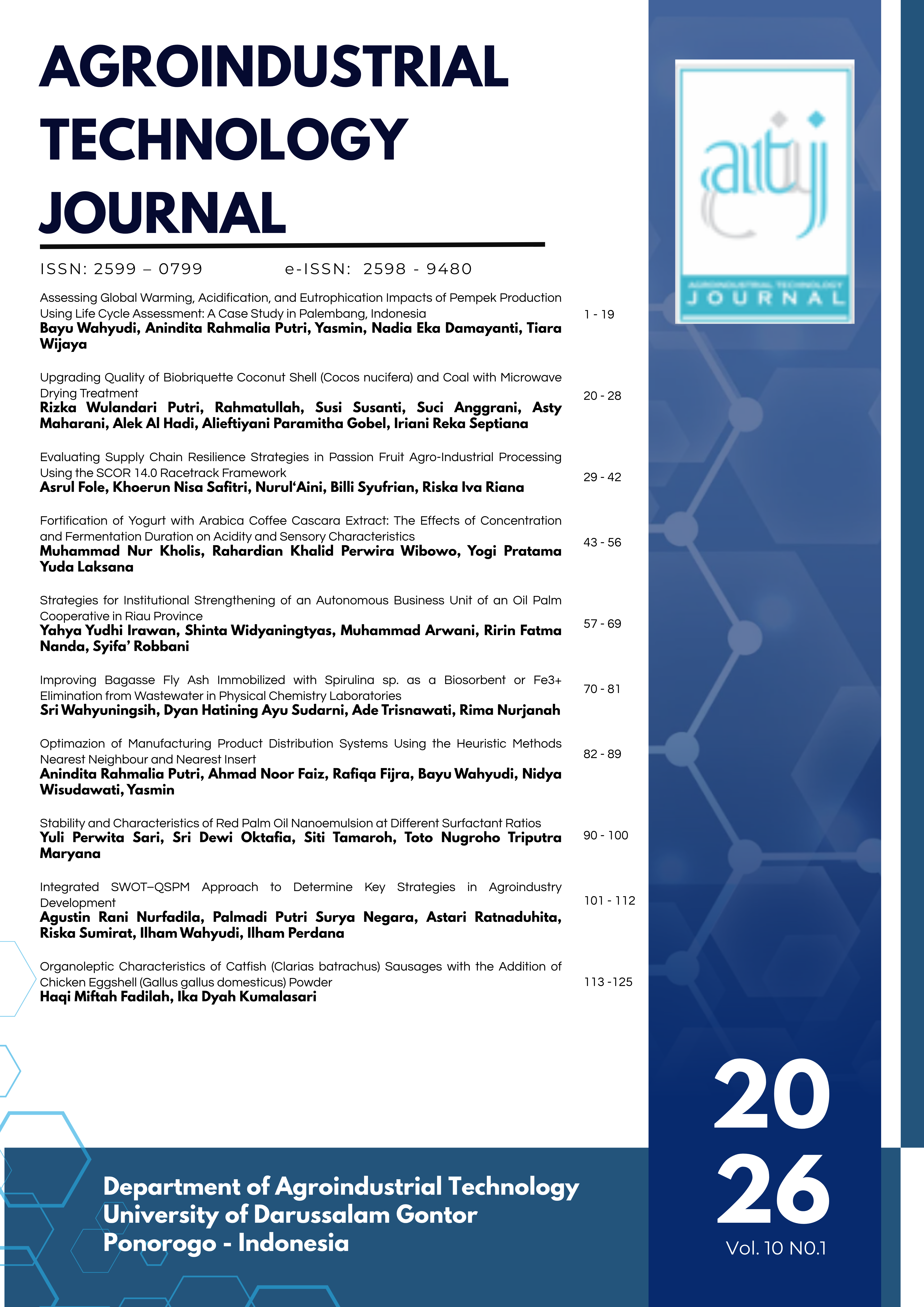
Stability and Characteristics of Red Palm Oil Nanoemulsions at Different Surfactant Ratios
DOI:
https://doi.org/10.21111/atj.v10i1.15Keywords:
β-carotene, nanoemulsions, palm oil, red palm oil, storageAbstract
β-carotene is a potent antioxidant naturally present in red palm oil (RPO) at concentrations of 500-700 ppm. Despite its significant nutritional and functional benefits, the application of β-carotene in aqueous food systems remains limited due to its hydrophobic nature and high sensitivity to heat, light, and oxygen. Therefore, the development of an effective lipid-based delivery system is required to improve its dispersibility and stability. Nanoemulsions, lipid-based carriers with nanosized droplets, have emerged as an effective approach for such applications. This study aimed to evaluate the stability and physicochemical characteristics of β-carotene nanoemulsion formulated using a red palm oil-palm oil blend and produced via a low-energy emulsification method (phase inversion). Tween 80 was used as the surfactant, and distilled water as the aqueous phase. The nanoemulsions were characterized based on turbidity, particle size distribution, polydispersity index (PDI), zeta potential, pH, viscosity, color attributes, and β-carotene retention during storage at room temperature. The results showed that the surfactant-to-oil ratio significantly influenced the physical stability of the nanoemulsions. The optimal formulation, achieved at a surfactant-to-oil ratio of 3:1, produced a nanoemulsion with an average particle size of approximately 200 nm, a low polydispersity index, and a stable zeta potential for up to four weeks. Chemical stability, as measured by β-carotene content, declined markedly after 3 weeks of storage. These findings indicate that blending red palm oil with palm oil enables the formation of physically stable nanoemulsions using a low-energy method. Nevertheless, further formulation optimization is required to enhance the chemical stability of β-carotene for prolonged storage and potential application in aqueous food systems.
References
Akram, S., Anton, N., Omran, Z., & Vandamme, T. (2021). Water-in-Oil Nano-Emulsions Prepared by Spontaneous Emulsification : New Insights on the Formulation Process. Pharmaceutics, 13(1030), 1–12.
Davidov-Pardo, G., & Mcclements, D. J. (2015). Nutraceutical delivery systems : Resveratrol encapsulation in grape seed oil nanoemulsions formed by spontaneous emulsification. Food Chemistry, 167, 205–212. https://doi.org/10.1016/j.foodchem.2014.06.082
Dewandari, K. T., & Sofwan, G. (2022). Effects of Variation Emulsifier on Stability of Red Palm Oil Nanoemulsion (Elaeis guineensis Jacq). IOP Conference Series: Earth and Environmental Science, 1024(1). https://doi.org/10.1088/1755-1315/1024/1/012007
Dewandari, K. T., Sofwan, G., & Tjahyono, H. (2019). Effect of Emulsifier Variation on The Stability of Carotene Nanoemulsion. IOP Conference Series: Earth and Environmental Science, 309(1), 012046. https://doi.org/10.1088/1755-1315/309/1/012046
Jo, Y., & Kwon, Y. (2014). Characterization of β -Carotene Nanoemulsions Prepared by Microfluidization Technique. Food Science and Biotechnology, 23(1), 107–113. https://doi.org/10.1007/s10068-014-0014-7
Kusbandari, A., & Susanti, H. (2017). Kandungan Beta Karoten dan Aktivitas Penangkapan Radikal Bebas Terhadap DPPH (1,1-Difenil 2-Pikrihydrazil) Ekstrak Buah Blewah (Cucumis Melo Var. Cantalupensis L) Secara Spektrofotometri UV-Visibel. Journal of Pharmaceutical Sciences and Community, 14(1), 37–42. https://doi.org/10.24071/jpsc.141562
Liu, Y., Hou, Z., Yang, J., & Gao, Y. (2014). Effects of antioxidants on the stability of β-Carotene in O/W emulsions stabilized by Gum Arabic. Journal of Food Science and Technology, 52(June), 3300–3311. https://doi.org/10.1007/s13197-014-1380-0
López-Monterrubio, D. I., Lobato-Calleros, C., Vernon-Carter, E. J., & Alvarez-Ramirez, J. (2021). Influence of β-carotene concentration on the physicochemical properties, degradation and antioxidant activity of nanoemulsions stabilized by whey protein hydrolyzate-pectin soluble complexes. LWT, 143, 111148. https://doi.org/10.1016/j.lwt.2021.111148
Luketsi, W. P., Wicaksono, A. H., & Rohmah, D. U. M. (2022). Formulasi Sabun Cuci Tangan Cair dengan Kombinasi Ekstrak Kopi Robusta (Coffea canephora) Ngebel Ponorogo. Agroindustrial Technology Journal, 6(1), 14–23. https://doi.org/10.21111/atj.v6i1.6729
Mba, O. I., Dumont, M.-J., & Ngadi, M. (2015). Palm oil: Processing, characterization and utilization in the food industry – A review. Food Bioscience, 10, 26–41. https://doi.org/10.1016/j.fbio.2015.01.003
Mehmood, T., Ahmed, A., & Ahmed, Z. (2021a). Food-Grade Nanoemulsions for the Effective Delivery of β Carotene. Langmuir, 37, 3086–3092. https://doi.org/10.1021/acs.langmuir.0c03399
Mehmood, T., Ahmed, A., & Ahmed, Z. (2021b). Food-grade nanoemulsions for the effective delivery of β carotene. Langmuir, 37(10), 3086–3092. https://doi.org/10.1021/acs.langmuir.0c03399
Ozturk, B., & Mcclements, D. J. (2016). Progress in natural emulsifiers for utilization in food emulsions. Current Opinion in Food Science, 7, 1–6. https://doi.org/10.1016/j.cofs.2015.07.008
Pignitter, M., Hernler, N., Zaunschirm, M., Kienesberger, J., Somoza, M., Kraemer, K., & Somoza, V. (2016). Evaluation of Palm Oil as a Suitable Vegetable Oil for Vitamin A Fortification Programs. Nutrients, 8(6), 378. https://doi.org/10.3390/nu8060378
Pulungan, M. Z. N., Luketsi, W. P., & Miftahul, D. U. (2021). Pembuatan Fruit Leather Buah Nanas (Ananas comosus L) Subgrade dengan Penambahan Kulit Buah Naga Merah (Hylocerus costaricencis). Agroindustrial Technology Journal, 4(2), 182. https://doi.org/10.21111/atj.v4i2.4035
Qian, C., Decker, E. A., Xiao, H., & Mcclements, D. J. (2012). Nanoemulsion delivery systems : Influence of carrier oil on b -carotene bioaccessibility. Food Chemistry, 135(3), 1440–1447. https://doi.org/10.1016/j.foodchem.2012.06.047
Sari, F., Sinaga, K. R., & Siahaan, D. (2018). Formulation and Evaluation of Red Palm Olein Nanoemulsion. Asian Journal of Pharmaceutical and Clinical Research, 11(9), 237–240. https://doi.org/10.22159/ajpcr.2018.v11i9.26532
Sari, Y. P., Raharjo, S., Santoso, U., & Supriyadi. (2020). Formulation, characterization and stability of o/w nanoemulsion containing rce bran oil prepared by emulsion phase inversion. Food Research, 4(August), 1024–1029. https://doi.org/https://doi.org/10.26656/fr.2017.4(4).409 Abstract
Sari, Y., Raharjo, S., Santoso, U., & Supriyadi, . (2022). Preventing Vitamin C Photooxidation in Beverage Model System by Virgin Coconut Oil-Rice Bran Oil Nanoemulsion. Proceedings of the 6th Food Ingredient Asia Conference (6th FiAC 2020) - Food Science, Nutrition and Health, 113–121. https://doi.org/10.5220/0010541900003108
Sulaiman, I., & Khairi, I. (2024). Pengukuran Masa Simpan Ikan Kering (Keumamah) Menggunakan Metode Accelerated Shelf-Life Testing(ASLT) dengan Model Arrhenius Menggunakan Microwave). Agroindustrial Technology Journal, 8(1), 118–127. https://doi.org/10.21111/atj.v8i1.11955
Surh, J., Decker, E. A., & Mcclements, D. J. (2017). Utilisation of spontaneous emulsification to fabricate lutein- loaded nanoemulsion-based delivery systems : factors influencing particle size and colour. International Journal of Food Sciences and Technology, 1–9. https://doi.org/10.1111/ijfs.13395
Wahyuni, N., & Sulistyani, T. (2021). Pemanfaatan Sukun Sebagai Bahan Alternatif Pembuatan Mayonaise Nabati Dengan Penambahan RPO (Minyak Sawit Merah) Sebagai Sumber Beta Karoten. Jurnal Socia Akademika, 7(2), 104–113.
Zhang, C., & Li, B. (2022). Fabrication of nanoemulsion delivery system with high bioaccessibility of carotenoids from Lycium barbarum by spontaneous emulsification. Food Science and Nutrition, 10(8), 2582–2589. https://doi.org/10.1002/fsn3.2863
Zhong, J., Liu, X., Wang, Y., Qin, X., & Li, Z. (2017). γ-Oryzanol Nanoemulsions Produced by a Low-Energy Emulsification Method: an Evaluation of Process Parameters and Physicochemical Stability. The Royal Society of Chemistry. https://doi.org/10.1039/c7fo00023e
Downloads
Submitted
Accepted
Published
How to Cite
Issue
Section
License
Copyright (c) 2026 Agroindustrial Technology Journal

This work is licensed under a Creative Commons Attribution-NonCommercial-ShareAlike 4.0 International License.
The author whose published manuscript approved the following provisions:
1. The right of publication of all material published in the journal / published in the Agroindustrial Technology Journal is held by the editorial board with the knowledge of the author (moral rights remain the author of the script).
2. The formal legal provisions for access to digital articles of this electronic journal are subject to the terms of the Creative Commons Attribution-NonCommercial-ShareAlike 4.0 International License (CC BY-NC-SA 4.0), which means that Agroindustrial Technology Journal reserves the right to save, transmit media or format, Database), maintain, and publish articles without requesting permission from the Author as long as it keeps the Author's name as the owner of Copyright.
3. Printed and electronically published manuscripts are open access for educational, research and library purposes. In addition to these objectives, the editorial board shall not be liable for violations of copyright law.