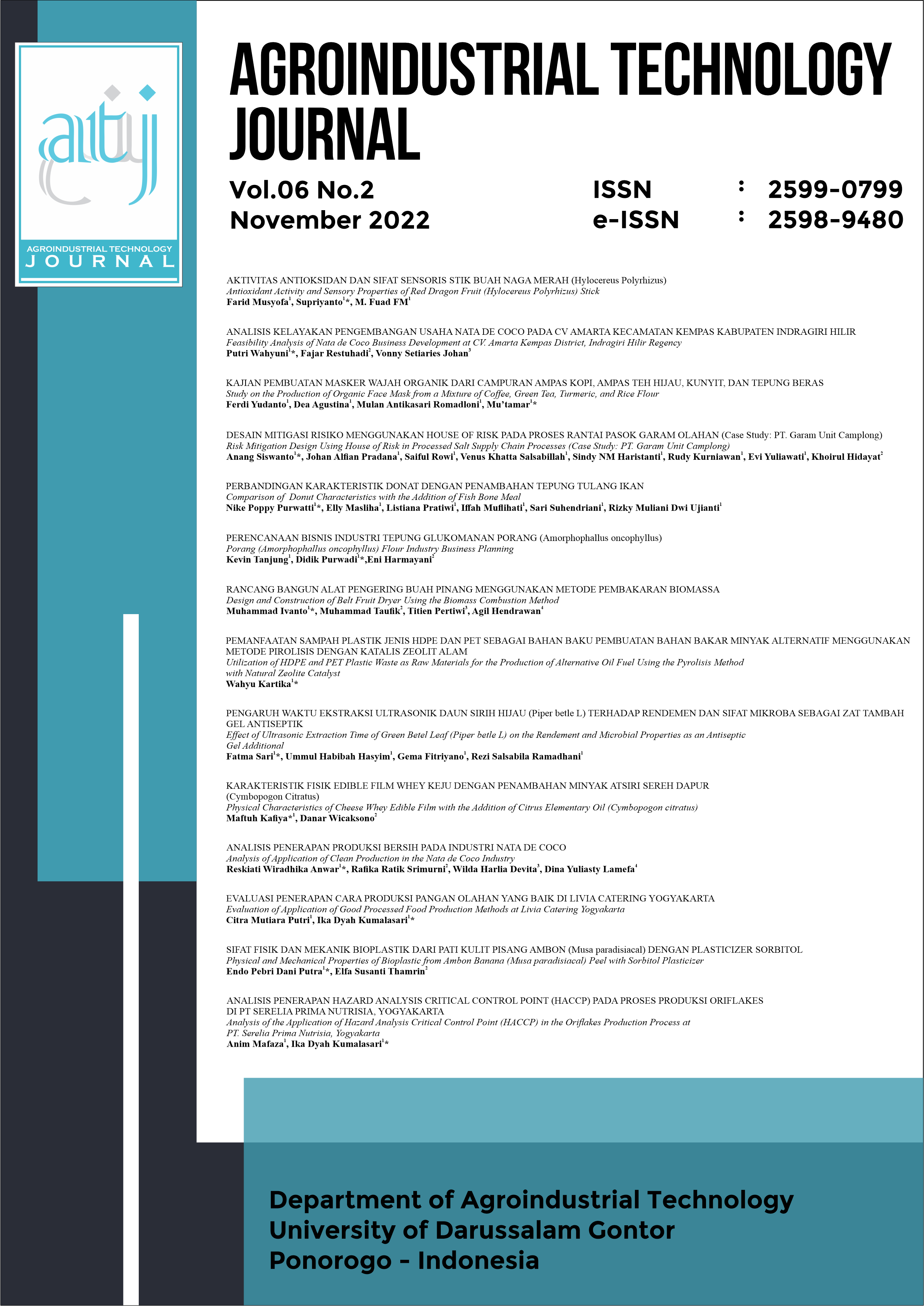
PEMANFAATAN SAMPAH PLASTIK JENIS HDPE DAN PET SEBAGAI BAHAN BAKU PEMBUATAN BAHAN BAKAR MINYAK ALTERNATIF MENGGUNAKAN METODE PIROLISIS DENGAN KATALIS ZEOLIT ALAM
Utilization Of HDPE And PET Plastic Waste As Raw Materials For Manufacturing Alternative Fuel Using Pyrolysis Method With Natural Zeolite Catalyst
Keywords:
plastic waste, alternative fuel oil, pyrolysis, zeolite catalystAbstract
Plastic waste is still a serious environmental problem, along with economic growth and increasing population. Plastic is an inorganic material that is difficult to decompose naturally, so alternative processing is needed to reduce the volume of plastic waste. One way is to use plastic waste as a raw material for making alternative fuel oil with the pyrolysis method. This can be done because plastic is a derivative product of petroleum so it has a high calorific value like existing commercial fuels. Pyrolysis is the process of fracturing or breaking polymer chains into simpler compounds through a thermal process with, without or with little oxygen. The purpose of this study was to determine the composition of raw material weight, catalyst weight, temperature and optimal reaction time in the manufacture of alternative fuel oil from a mixture of HDPE and PET plastic waste using the pyrolysis method with the help of a natural zeolite catalyst and its quality according standards lto oil and gas. The results showed that the quality of pyrolysis oil with an optimal composition of weight of raw materials for plastic waste HDPE and PET 500 g, natural zeolite catalyst 200 g, temperature 4000C and reaction time of 30 minutes was included in the standard range of diesel oil according to iDecree and Director General Gas No. 28.K/10/DJM. T/2016, with laboratory test results for viscosity parameters 3.02 mm2/s, density 851.2 kg/m3, heating value 10,228.8 kcal/kg, boiling point 2150C and water content 288 mg/kg.
References
Arita, S., Assalami, A., & Naibaho, D. I. (2015). Proses Pembuatan Bahan Bakar Cair Dengan Menggunakan Katalis Zeolit. Teknik Kimia, 21(2), 8–14.
Hamidi, N. (2013). Pyrolysis of Household Plastic Wastes. British Journal of Applied Science & Technology, 3(3), 417–439. https://doi.org/10.9734/bjast/2014/1984
Hidayat, F. F. D., & Siregar, I. H. (2022). Uji Karakteristik Minyak Pirolisis Berbahan Baku Limbah Plastik Polypropylene. Jtm, 10(01), 13–20. https://ejournal.unesa.ac.id/index.php/jtm-unesa/article/view/43904
Hidayati, N. U. R. A., Aziz, I. R., Muthiadin, C. U. T., Yasin, J. H. M., No, L., Gowa, K., & Selatan, S. (2017). Pemanfaatan Limbah Plastik Sebagai Alternatif Bahan Bakar Terbarukan. November, 35–37.
Iswadi, D., Nurisa, F., & Liastuti, E. (2017). Pemanfaatan sampah plastik LDPE dan PET menjadi bahan bakar minyak dengan proses pirolisis. Jurnal Ilmiah Teknik Kimia UNPAM, 1(2), 1–9. openjournal.unpam.ac.id/index.php/JITK/article/download/718/585
Kurniawan, E., & Nasrun. (2014). Karakterisasi Bahan Bakar Dari Sampah Plastik Jenis High Density Polyethylene (HDPE) dan Low Density Polyethylene (LDPE). 2(November), 41–52.
Kurniawan, S. D., & Saptoadi, H. (2016). Pengaruh Massa Katalis Zeolit Alam Pada Proses Pirolisis Limbah Plastik Low Density Polyethylene ( LDPE ). 9(1).
MenLHK, Dirjen Pengelolaan Sampah, L. dan B. (2020). Sistim Informasi Pengelolaan Sampah Nasional. Kementerian Lingkungan Hidup dan Kehutanan Republik Indonesia. https://sipsn.menlhk.go.id/
Nasrun, N., Kurniawan, E., & Sari, I. (2017). Studi Awal Produksi Bahan Bakar Dari Proses Pirolisis Kantong Plastik Bekas. Jurnal Teknologi Kimia Unimal, 5(1), 30. https://doi.org/10.29103/jtku.v5i1.77
Nazif, R., Wicaksana, E., Kimia, D. T., Teknik, F., & Utara, U. S. (2016). Karbon Aktif Terhadap Yield dan Kualitas Bahan. 5(3), 49–55.
Pratiwi, R., & Dahani, W. (2015). Pengaruh Penggunaan Katalis Zeolit Alam Dalam Pirolisis Limbah Plastik Jenis HDPE Menjadi Bahan Bakar Cair Setara Bensin. Seminar Nasional Sains Dan Teknologi Fakultas Teknik Universitas Muhammadiyah Jakarta, 1(1), 1–5.
Sari, G. L. (2018). Kajian Potensi Pemanfaatan Sampah Plastik Menjadi Bahan Bakar Cair. Al-Ard: Jurnal Teknik Lingkungan, 3(1), 6–13. https://doi.org/10.29080/alard.v3i1.255
Surono Untoro Budi, I. (2016). Pengolahan Sampah Plastik Jenis PP, PET, dan PE Menjadi Bahan Bakar Minyak dan Karakteristiknya. Mekanika Dan Sistem Termal, 1(1), 32–37.
Syamsiro, M. (2015). Kajian Pengaruh Penggunaan Katalis Terhadap Kualitas Produk. Teknik, 5(1), 1–85.
UNEP. (2009). Converting Waste Plastics into A Resources. Assessment Guidelines, 73.
Wahyudi, J., Prayitno, H. T., & Astuti, A. D. (2018). Pemanfaatan Limbah Plastik Sebagai Bahan Baku Pembuatan Bahan Bakar Alternatif. Litbang, XIV, 58–67.
Downloads
Submitted
Published
How to Cite
Issue
Section
License
Copyright (c) 2026 Agroindustrial Technology Journal

This work is licensed under a Creative Commons Attribution-NonCommercial-ShareAlike 4.0 International License.
The author whose published manuscript approved the following provisions:
1. The right of publication of all material published in the journal / published in the Agroindustrial Technology Journal is held by the editorial board with the knowledge of the author (moral rights remain the author of the script).
2. The formal legal provisions for access to digital articles of this electronic journal are subject to the terms of the Creative Commons Attribution-NonCommercial-ShareAlike 4.0 International License (CC BY-NC-SA 4.0), which means that Agroindustrial Technology Journal reserves the right to save, transmit media or format, Database), maintain, and publish articles without requesting permission from the Author as long as it keeps the Author's name as the owner of Copyright.
3. Printed and electronically published manuscripts are open access for educational, research and library purposes. In addition to these objectives, the editorial board shall not be liable for violations of copyright law.