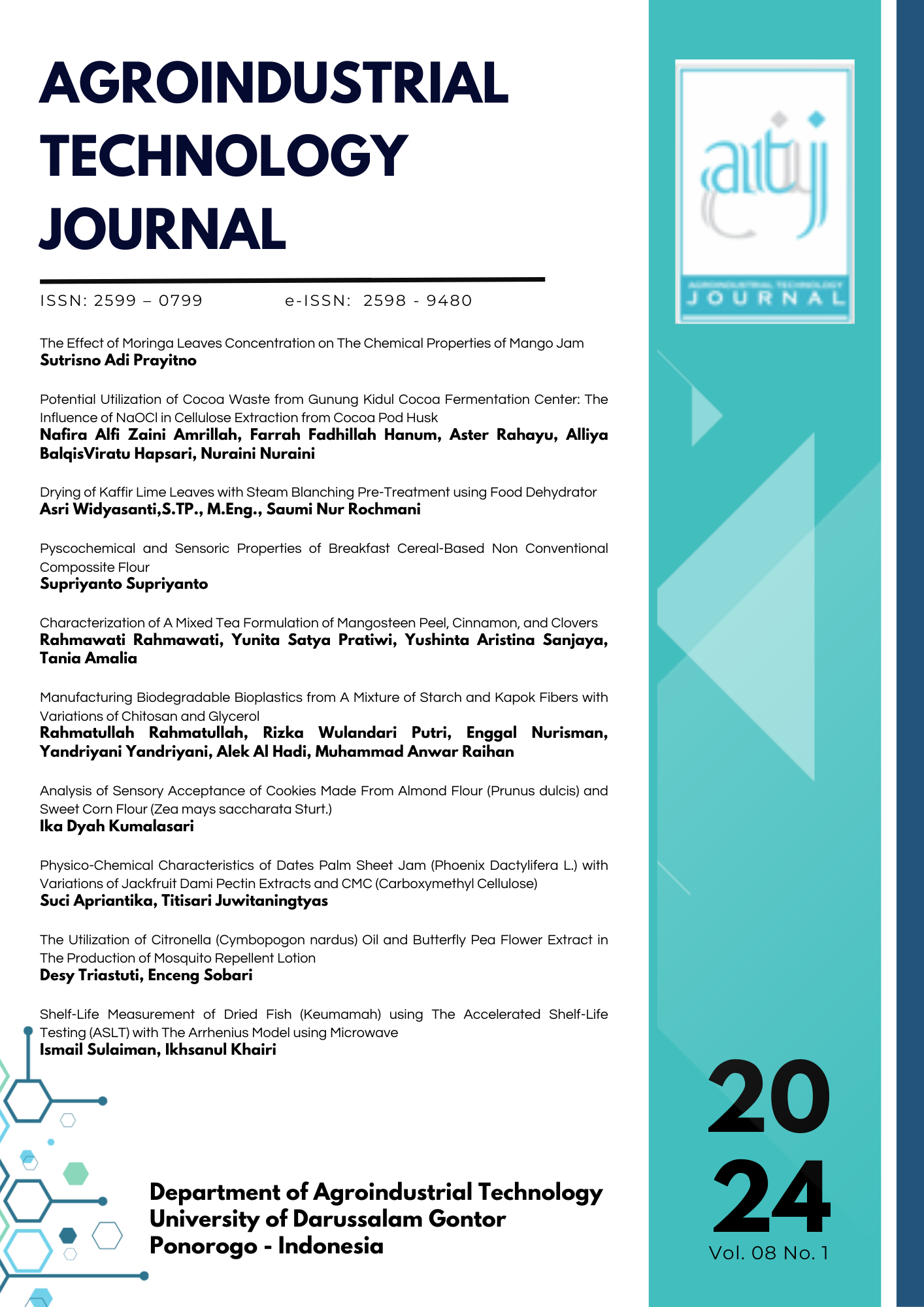
The Effect Of Moringa Leaves Concentration On The Chemical Properties Of Mango Jam
Keywords:
Chemicals properties, Mango jam, MoringaAbstract
Mango fruit has perishable food properties, so a technological touch is needed in the form of a preserved product in the form of jam. Jam is an Intermediate Moisture foods ( IMF) productthathas health benefits if added with ingredients that have active compounds.The purpose of adding compounds or other substances in making jam products is to improve nutritional status and increase compounds that are beneficial for body health in food for health. Moringa is a plant that has the potential to make jam. Moringa has many compounds including vitamins, minerals, glycosides, Fe, flavonoids, phenols, and antioxidants. This research aims to analyze the chemical characteristics of mango jam products which include pH, total acid, vitamin C and antioxidants. The research design used a Completely Randomized Design. The variables used were a pectin concentrationof 1% for all treatments and and fresh Moringa leaf concentrations of 8%, 6%, 4% and 2%. The chemical test data obtained were analyzed using variance analysis (ANOVA) with an α test level of 5% and continued with the Duncan test. The data was analyzed using SPSS for Windows version 25. The research results showed the use of Moringa leaves and pectin influences on the quality of mango jam. Moringa leaves can increase the antioxidant status (IC50) of mango jam. The concentration of moringa leaves (8%) could provide optimal IC50 values. These results could be continued for further research on optimizing the use of fresh Moringa leaves to produce jam products to get product standards
References
Agustina WW, Handayani NM. (2016). Pengaruh penambahan wortel (Daucus carota) terhadap karakteristik sensorik dan fisikokimia selai buah naga merah (Hyloreceus polyrhizuz). Fortech, 1(1).Basu S, Shivhare US, Singh TV, Beniwal VS. (2011). Rheological, textural and spectral characteristics of sorbitol substituted mango jam. J Food Eng.105 (3): 503–512. DOI: https://doi.org/10.1016/j.jfoodeng.2011.03.014Bekele, M., Satheesh, N., & Sadik, J. A. (2020). Screening of Ethiopian mango cultivars for suitability for preparing jam and determination of pectin, sugar, and acid effects on physico-chemical and sensory properties of mango jam. Scientific African, 7, 1–10. https://doi.org/10.1016/j.sciaf.2020.e00277Chalchisa T, Zegeye A, Dereje B, Tolesa Y. (2022). Effect of sugar, pectin, and processing temperature on the qualities of pineapple jam. Int J Fruit Sci.22 (1): 711–724.https://doi.org/10.1080/155-38362.2022.2113598Deeksha K, Sunita M. (2018). Utilization of mango and its by-products by different processing methods. Asian J Sci & Tech.09 (10): 8896–8901. http://www.journalajst.comDorlan S, Evy R. (2017). Penambahan pektin dalam pembuatan selai lembaran buah pedada (Sonneratia caseolaris). Jom Fak Pert.4 (2): 1–14.Giuberti G, Rocchetti G, Montesano D, Lucini L. (2021). The potential of Moringa oleiferain food formulation: a promising source of functional compounds with health-promoting properties. Cur Op in Food Sci.42 (1): 257–269.https://doi.org/10.1016/j.cof-s.2021.09.001Gopalakrishnan L, Doriya K, Kumar DS. (2016). Moringa oleifera: A review on nutritive importance and its medicinal application. Food Sci & Hum Well.5 (2): 49–56.https://doi.org/10.1016/-j.fshw.2016.04.001 Gutema T, Tadesse A. (2022). Assessment of post-harvest handling of mango and evaluation of mango jam in major mango producing areas of South Omo Zone, SNNPR, Ethiopia. Int J Agril Res Innov Tech.12 (1): 155–160.Gutema T, Tadesse, A. (2015). Assessment of post-harvest handling of mango and evaluation of mango jam in major mango producing areas of South Omo Zone, SNNPR, Ethiopia. Ag Econ Search. 12 (1): 155–160.Irawan T, Rahmi S. (2023). Making star fruit jam wuluh with the addition of moringa leaf extract to increase msmes for the community of Babul Makmur village. Serambi J Agri Tech.5 (2): 117–133.Kashyap P, Kumar S, Riar CS, Jindal N, Baniwal P, Guiné RPF, Correia PMR, Mehra R, Kumar H. (2022). Recent advances in drumstick (Moringa oleifera) leaves bioactive compounds: composition, health benefits, bioaccessibility, and dietary applications. Antioxidants. 11 (2): 1–37.https://doi.org/10.3390/antiox11020402Mandey L, Mamuaja C. (2016). Teknologi produksi jam mangga (Mangifera indica). J Ilm & Tekn Pang.4 (1): 28–35.Martins MP, Geremias-Andrade IM, Ferreira LDS, Brito-Oliveira TC, de PINHO SC. (2021). Technological and sensory feasibility of enrichment of low-sugar mango jams with curcumin encapsulated in lipid microparticles. Food Sci & Tech (Brazil). 41 (1): 74–81. https://doi.org/10.1590/fst.33519Maryani NW, Suriati L, Candra I. (2023). Addition of sugar and CMC to the characteristics of Arumanis mango jam (Mangifera indica L.). SEAS (Sust Env Agr Sci). 7 (1): 39–51. https://doi.org/10.22225/seas.7.1.6599.39-51Maya F, Irfin Z. (2023). Pengaruh rasio penambahan pektin pada pembuatan selai mangga, nanas dan sirsak. DISTILAT: J Tekn Sep.7 (2): 147–154. https://doi.org/10.33795/distilat.v7i2.199Nuapia Y, Cukrowska E, Tutu H, Chimuka L. (2020). Statistical comparison of two modeling methods on pressurized hot water extraction of vitamin C and phenolic compounds from Moringa oleiferaleaves. South Afri J Bot. 129 (1):9–16.https://doi.org/10.1016/j.sa-jb.2018.09.001Nuraini V, Karyantina M. (2019). Pengaruh waktu pemanasan dan penambahan air terhadap aktivitas antioksidan selai buah bit (Beta vulgaris L.). FoodTech: J Tekn Pang. 2 (1): 26. DOI: https://doi.org/10.26418/jft.v2i1.38021Nurani FP. (2020). Penambahan penambahan pektin, gula, dan asam sitrat dalam
pembuatan selai dan marmalade buah-buahan. J Food Tech & Agro.2 (1): 27–32.https://doi.org/10.24929/jfta.v2i1.924Oyeyinka A, Samson A. (2018). Moringa oleiferaas a food fortificant: Recent trends and prospects. J the Saudi Soc Agri Sci.17 (2): 127–136. DOI: https://doi.org/10.1016/j.jssas.2016.02.002Prayitno S, Patria D, Mardiana N, Utami D, Kusumawati R, Rochma N, Niam M. (2022). Fortification of Moringa oleifera flour on quality of wet noodle. Food Sci & Tech J.4 (2): 63–70. DOI: https://doi.org/https://doi.org/10.25139/fst.v4i2.4236 CaRatrinia PW, Sumartini, Hasibuan NE. (2022). The effect of addition different types of binders to the effervescent chemical characteristics of Sonneratia casolarisfruits. IOP Conf Series: Earth & Env Sci.967 (1). https://doi.org/10.1088/17551315/967/1/012049Santosa AP, Hajoeningtijas OD, Noviandita I. (2021). Karakteristik fisikokimia dan sensoris selai bengkuang (Pachyrhizus Erosus L.) dengan penambahan pektin dan asam sitrat pada berbagai konsentrasi. Proceed Series on Phys & Form Sci.2 (1): 77–83. DOI: https://doi.org/10.30595/pspfs.v2i.170Sogi DS, Siddiq M, Greiby I, Dolan KD. (2013). Total phenolics, antioxidant activity, and functional properties of “Tommy Atkins” mango peel and kernel as affected by drying methods. Food Chem.141 (3): 2649–2655. DOI: https://doi.org/10.1016/j.foodchem.2013.05.053Stohs SJ, Hartman MJ. (2015). Review of the safety and efficacy of Moringa oleifera. Phyto Res.29 (6): 796–804. DOI: https://doi.org/10.1002/ptr.5325Sutwal R, Dhankhar J, Kindu P, Mehla R. (2019). Development of low calorie jam by replacement of sugar with natural sweetener stevia. Int J Curr Res & Rev.11 (4): 9–16. DOI: https://doi.org/10.31782/IJCRR.2019.11402Syafriani E, Handayani VDS, Kurniasih B, Irwan SNR, Muhartini S. (2022). Pelatihan pembuatan selai mangga sebagai produk olahan tabulampot di masyarakat Dusun Sendowo Yogyakarta. J SOLMA. 11 (2): 370–380.https://doi.org/10.22236/solma.v11i2.9281Vongsak B, Sithisarn P, Gritsanapan W. (2014). Simultaneous HPLC quantitative analysis of active compounds in leaves of Moringa oleiferaL. J Chrom Sci.52 (7): 641–645.https://doi.org/10.1093/chromsci/bmt093
Downloads
Submitted
Published
How to Cite
Issue
Section
License
Copyright (c) 2024 The Author (s)

This work is licensed under a Creative Commons Attribution-NonCommercial-ShareAlike 4.0 International License.
The author whose published manuscript approved the following provisions:
1. The right of publication of all material published in the journal / published in the Agroindustrial Technology Journal is held by the editorial board with the knowledge of the author (moral rights remain the author of the script).
2. The formal legal provisions for access to digital articles of this electronic journal are subject to the terms of the Creative Commons Attribution-NonCommercial-ShareAlike 4.0 International License (CC BY-NC-SA 4.0), which means that Agroindustrial Technology Journal reserves the right to save, transmit media or format, Database), maintain, and publish articles without requesting permission from the Author as long as it keeps the Author's name as the owner of Copyright.
3. Printed and electronically published manuscripts are open access for educational, research and library purposes. In addition to these objectives, the editorial board shall not be liable for violations of copyright law.