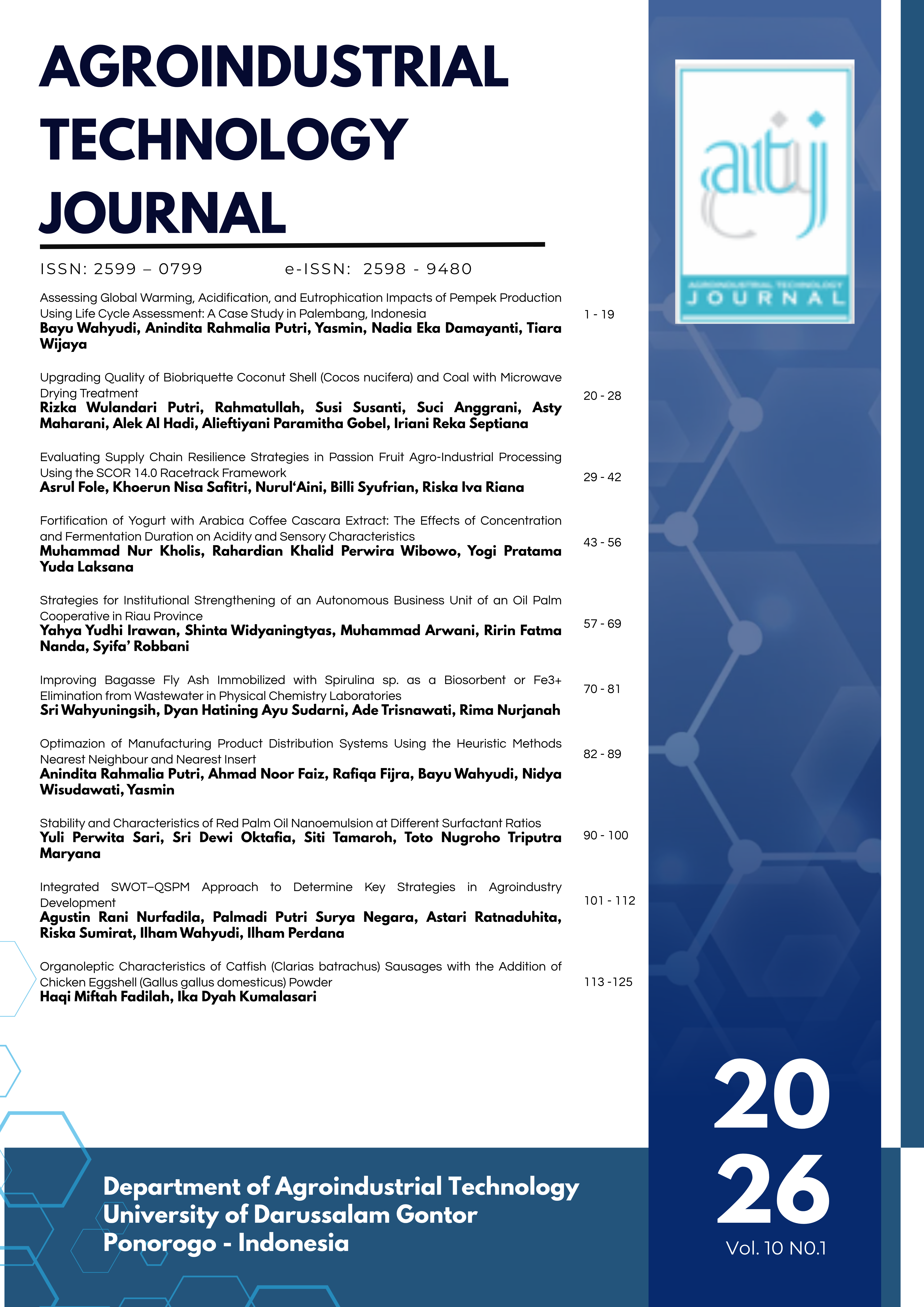
Fortification of Yogurt with Arabica Coffee Cascara Extract: The Effects of Concentration and Fermentation Duration on Acidity and Sensory Characteristics
DOI:
https://doi.org/10.21111/atj.v10i1.30Keywords:
acidification, cascara coffee, fermentation duration, sensory acceptance, yogurtAbstract
Coffee cascara, a by-product of coffee processing, is a potential source of bioactive compounds such as polyphenols and chlorogenic acids. However, its application in yogurt fermentation systems remains limited. Therefore, this study aimed to evaluate the effect of cascara extract concentration and fermentation time on the physicochemical and sensory properties of yogurt. This study aimed to evaluate the effect of Arabica coffee cascara extract concentration (water-based) and fermentation duration on the acidity characteristics and sensory acceptance of yogurt. The experiment was conducted using a factorial completely randomized design with two factors: cascara extract concentration (1.5%, 2%, and 2.5% w/v) and fermentation duration (3 and 6 hours). The evaluated parameters included pH, titratable acidity (TA), and sensory attributes (color, aroma, taste, and overall acceptance) assessed using a hedonic test with untrained panellists The results demonstrated that fermentation duration significantly influenced yogurt acidification, resulting in lower pH values and higher titratable acidity as fermentation duration increased. The pH values ranged from 4.63 to 4.92, while titratable acidity ranged from 0.58% to 0.75% lactic acid. The addition of cascara extracts up to 2.5% did not inhibit the metabolic activity of lactic acid bacteria during fermentation. Sensory evaluation indicated that yogurt containing 2% cascara extract fermented for 6 hours obtained the highest overall acceptance score, indicating an optimal balance between acidity and sensory characteristics. These findings demonstrated that Arabica coffee cascara extract has potential as a functional ingredient in yogurt production while supporting the valorization of coffee processing by-products into value-added fermented dairy products.
References
Ahmad, I., Wang, B., Zhang, M., Zhu, Y., Chen, S., & Ye, X. (2026). Fortification of yogurt with teas and tea compounds associated challenges and elucidations - A review. Applied Food Research, 6(1), 101857. https://doi.org/https://doi.org/10.1016/j.afres.2026.101857
An, M., Zhao, Z., Zhao, L., Yang, J., Gao, H., Zhang, L., Zhao, G., Hou, B., He, J., Hung, W. L., Li, B., Yu, Y., Ge, S., Li, X., & Wang, R. (2025). Metabolic Modulation of Yogurt Fermentation Kinetics and Storage Stability by Lactobacillus-Starter Culture Interactions. Foods, 14(17), 1–17. https://doi.org/10.3390/foods14172935
AOAC. (1995). Official Method of Analysis of AOAC International. AOAC International. USA.
Arpi, N., Muzaifa, M., Sulaiman, M. I., Andini, R., & Kesuma, S. I. (2021). Chemical Characteristics of Cascara, Coffee Cherry Tea, Made of Various Coffee Pulp Treatments. IOP Conference Series: Earth and Environmental Science, 709(1). https://doi.org/10.1088/1755-1315/709/1/012030
Aryana, K. J., & Olson, D. W. (2017). A 100-Year Review: Yogurt and other cultured dairy products. Journal of Dairy Science, 100(12), 9987–10013. https://doi.org/10.3168/JDS.2017-12981
Ayivi, R. D., & Ibrahim, S. A. (2022). Lactic acid bacteria: an essential probiotic and starter culture for the production of yoghurt. International Journal of Food Science and Technology, 57(11), 7008–7025. https://doi.org/10.1111/ijfs.16076
Balivo, A., d’Errico, G., & Genovese, A. (2024). Sensory properties of foods functionalised with milk proteins. Food Hydrocolloids, 147, 109301. https://doi.org/10.1016/J.FOODHYD.2023.109301
Barukčić, I., Filipan, K., Lisak Jakopović, K., Božanić, R., Blažić, M., & Repajić, M. (2022). The Potential of Olive Leaf Extract as a Functional Ingredient in Yoghurt Production: The Effects on Fermentation, Rheology, Sensory, and Antioxidant Properties of Cow Milk Yoghurt. Foods, 11(701).
Dabija, A., Codină, G. G., Ropciuc, S., Gâtlan, A.-M., & Rusu, L. (2018). Assessment of the Antioxidant Activity and Quality Attributes of Yogurt Enhanced with Wild Herbs Extracts. Journal of Food Quality, 2018(1), 5329386. https://doi.org/https://doi.org/10.1155/2018/5329386
De Montijo-Prieto, S., Razola-Díaz, M. del C., Barbieri, F., Tabanelli, G., Gardini, F., Jiménez-Valera, M., Ruiz-Bravo, A., Verardo, V., & Gómez-Caravaca, A. M. (2023). Impact of Lactic Acid Bacteria Fermentation on Phenolic Compounds and Antioxidant Activity of Avocado Leaf Extracts. Antioxidants, 12(2), 1–17. https://doi.org/10.3390/antiox12020298
DePaula, J., Cunha, S. C., Cruz, A., Sales, A. L., Revi, I., Fernandes, J., Ferreira, I. M. P. L. V. O., Miguel, M. A. L., & Farah, A. (2022). Volatile Fingerprinting and Sensory Profiles of Coffee Cascara Teas Produced in Latin American Countries. Foods, 11(19), 1–20. https://doi.org/10.3390/foods11193144
Dwiki Ramadhan, A., Wilda Maslachah, L., Amallia Kurniati Nurjannah, D., Setyawardani, T., Sumarmono, J., Fadhlurrohman, I., & Dhia Arkan, N. (2024). Sifat Fisikokimia dan Organoleptik Yoghurt dengan Fortifikasi Teh Pandan (Pandanus amaryllifolius Roxb.). Jurnal Ilmiah Peternakan Halu Oleo, 6(4), 336–344. https://doi.org/10.56625/jipho.v6i4.67
Elkot, W. F., & Ismail, H. A. (2025). Technological advances in functional dairy foods and their role in human nutrition: A review. Aswan Journal of Agricultural and Biological Sciences, 1(1), 24–33. https://doi.org/10.21608/ajabs.2025.397996.1005
Filannino, P., Bai, Y., Di Cagno, R., Gobbetti, M., & Gänzle, M. G. (2015). Metabolism of phenolic compounds by Lactobacillus spp. during fermentation of cherry juice and broccoli puree. Food Microbiology, 46, 272–279. https://doi.org/10.1016/J.FM.2014.08.018
Granato, D., Branco, G. F., Cruz, A. G., Faria, J. de A. F., & Shah, N. P. (2010). Probiotic Dairy Products as Functional Foods. Comprehensive Reviews in Food Science and Food Safety, 9(5), 455–470. https://doi.org/https://doi.org/10.1111/j.1541-4337.2010.00120.x
Guglielmetti, A., Fernandez-Gomez, B., Zeppa, G., & Del Castillo, M. D. (2019). Nutritional quality, potential health promoting properties and sensory perception of an improved gluten-free bread formulation containing inulin, rice protein and bioactive compounds extracted from coffee byproducts. Polish Journal of Food and Nutrition Sciences, 69(2), 157–166. https://doi.org/10.31883/pjfns-2019-0012
Han, J., Chang, Y., Britten, M., St-Gelais, D., Champagne, C. P., Fustier, P., & Lacroix, M. (2019). Interactions of phenolic compounds with milk proteins. European Food Research and Technology, 245(9), 1881–1888. https://doi.org/10.1007/s00217-019-03293-1
Hartati, Hilmi, I., Nur, D., Awaludin, K., Fadhlurrohman, I., Arkan, N. D., Sumarmono, J., & Setyawardani, T. (2025). Fortifikasi teh rosella ungu (Hibiscus sabdariffa Linn) sebagai pewarna alami terhadap sifat fisikokimia dan organoleptik yogurt. Jurnal Triton, 16(1), 188–198.
Heeger, A., Kosińska-Cagnazzo, A., Cantergiani, E., & Andlauer, W. (2017). Bioactives of coffee cherry pulp and its utilisation for production of Cascara beverage. Food Chemistry, 221, 969–975. https://doi.org/10.1016/J.FOODCHEM.2016.11.067
Iriondo-Dehond, A., Iriondo-Dehond, M., & Del Castillo, M. D. (2020). Applications of Compounds from Coffee Processing By-Products. Biomolecules, 10(9), 1–20. https://www.ncbi.nlm.nih.gov/pmc/articles/PMC7564712/
Lachenmeier, D. W., Schwarz, S., Rieke-Zapp, J., Cantergiani, E., Rawel, H., Martín-Cabrejas, M. A., Martuscelli, M., Gottstein, V., & Angeloni, S. (2022). Coffee by-products as sustainable novel foods: Report of the 2nd international electronic conference on foods—“future foods and food technologies for a sustainable world.” Foods, 11(1). https://doi.org/10.3390/foods11010003
Lestari, W., Hasballah, K., Listiawan, M. Y., & Sofia, S. (2022). Coffee by-products as the source of antioxidants: a systematic review. F1000Research, 11(220), 1–12.
Li, S., Tao, Y., Li, D., Wen, G., Zhou, J., Manickam, S., Han, Y., & Chai, W. S. (2021). Fermentation of blueberry juices using autochthonous lactic acid bacteria isolated from fruit environment: Fermentation characteristics and evolution of phenolic profiles. Chemosphere, 276, 130090. https://doi.org/10.1016/J.CHEMOSPHERE.2021.130090
Maharani, S., Sugiarti, Y., Al-Falah, sarah A. N. W., & Prawira-Atmaja, M. I. (2021). Total Polyphenol and Antioxidant Activity of Tea Yoghurt with Caspian Sea Inoculum. Jurnal Ilmu Pangan dan Hasil Pertanian, 5(2), 181–190. https://doi.org/10.26877/jiphp.v5i2.10221
Mohamed Ahmed, I. A., Alqah, H. A. S., Saleh, A., Al-Juhaimi, F. Y., Babiker, E. E., Ghafoor, K., Hassan, A. B., Osman, M. A., & Fickak, A. (2021). Physicochemical quality attributes and antioxidant properties of set-type yogurt fortified with argel (Solenostemma argel Hayne) leaf extract. LWT, 137, 110389. https://doi.org/10.1016/J.LWT.2020.110389
Nemli, E., Ozkan, G., Gultekin Subasi, B., Cavdar, H., Lorenzo, J. M., Zhao, C., & Capanoglu, E. (2024). Interactions between proteins and phenolics: effects of food processing on the content and digestibility of phenolic compounds. Journal of the Science of Food and Agriculture, 104(5), 2535–2550. https://doi.org/https://doi.org/10.1002/jsfa.13275
Pramono, Y. B., Simbolon, M. P., & Susanti, S. (2021). Effect of Cascara Proportion on Melting Time and Hedonic Toward Color Preference of Ice Cream. Journal of Applied Food Technology, 8(2), 34–38. https://doi.org/10.17728/jaft.8454
Purbowati, I. S. M., Karseno, Maksum, A., & Ibrahim, I. A. (2023). Performance Improvement of Yogurt through the Variation of Roselle Extract Addition and Fermentation Time. Agrointek, 15(2), 477–485.
Râpă, M., Darie-Niță, R. N., & Coman, G. (2024). Valorization of Fruit and Vegetable Waste into Sustainable and Value-Added Materials. Waste, 2(3), 258–278. https://doi.org/10.3390/waste2030015
Rios, M. B., Iriondo-DeHond, A., Iriondo-DeHond, M., Herrera, T., Velasco, D., Gómez-Alonso, S., Callejo, M. J., & Del Castillo, M. D. (2020). Effect of coffee cascara dietary fiber on the physicochemical, nutritional and sensory properties of a gluten-free bread formulation. Molecules, 25(6). https://doi.org/10.3390/molecules25061358
Salehi, M., Ghorbani, M., Sadeghi Mahoonk, A., & Khomeiri, M. (2021). Physicochemical, antioxidant and sensory properties of yogurt fortified with common purslane (Portulaca oleracea) extract. Journal of Food Measurement and Characterization, 15(5), 4288–4296. https://doi.org/10.1007/s11694-021-00949-z
Sarker, A., Ahmmed, R., Ahsan, S. M., Rana, J., Ghosh, M. K., & Nandi, R. (2023). A comprehensive review of food waste valorization for the sustainable management of global food waste. Sustainable Food Technology, 2(1), 48–69. https://doi.org/10.1039/d3fb00156c
Soni, R., Jain, N. K., Shah, V., Soni, J., Suthar, D., & Gohel, P. (2020). Development of probiotic yogurt: effect of strain combination on nutritional, rheological, organoleptic and probiotic properties. Journal of Food Science and Technology, 57(6), 2038–2050. https://doi.org/10.1007/s13197-020-04238-3
Supriyanti, F. M. T., Roslina, D., Zackiyah, Z., & Hanifa, I. (2022). Strawberry-fortified Yogurt: Production, Sensory, Antioxidant Activity Test, and Model for Practicum. Indonesian Journal of Science and Technology, 7(3), 551–564. https://doi.org/10.17509/ijost.v7i3.51520
Tamime, A. Y., & Robinson, R. K. (2007). Tamime and Robinson’s yoghurt : science and technology (3rd ed.). CRC Press.
Tosif, M. M., Najda, A., Bains, A., Krishna, T. C., Chawla, P., Dyduch-Siemińska, M., Klepacka, J., & Kaushik, R. (2021). A comprehensive review on the interaction of milk protein concentrates with plant-based polyphenolics. International Journal of Molecular Sciences, 22(24). https://doi.org/10.3390/ijms222413548
Walstra, P., Wouters, J. T. M., & Geurts, T. J. (2005). Dairy Science and Technology (2 ed.). CRC Press.
Wibowo, N. A., Wanita, Y. P., Novitasari, E., Amri, A. F., Purwanto, E. H., Yulianti, Y., & Aurum, F. S. (2024). Innovative of cascara as potential in beverage, food and their functional impact: a review. International Journal of Food Science and Technology, 59(11), 8082–8092. https://doi.org/10.1111/ijfs.17562
Downloads
Submitted
Accepted
Published
How to Cite
Issue
Section
License
Copyright (c) 2026 Agroindustrial Technology Journal

This work is licensed under a Creative Commons Attribution-NonCommercial-ShareAlike 4.0 International License.
The author whose published manuscript approved the following provisions:
1. The right of publication of all material published in the journal / published in the Agroindustrial Technology Journal is held by the editorial board with the knowledge of the author (moral rights remain the author of the script).
2. The formal legal provisions for access to digital articles of this electronic journal are subject to the terms of the Creative Commons Attribution-NonCommercial-ShareAlike 4.0 International License (CC BY-NC-SA 4.0), which means that Agroindustrial Technology Journal reserves the right to save, transmit media or format, Database), maintain, and publish articles without requesting permission from the Author as long as it keeps the Author's name as the owner of Copyright.
3. Printed and electronically published manuscripts are open access for educational, research and library purposes. In addition to these objectives, the editorial board shall not be liable for violations of copyright law.