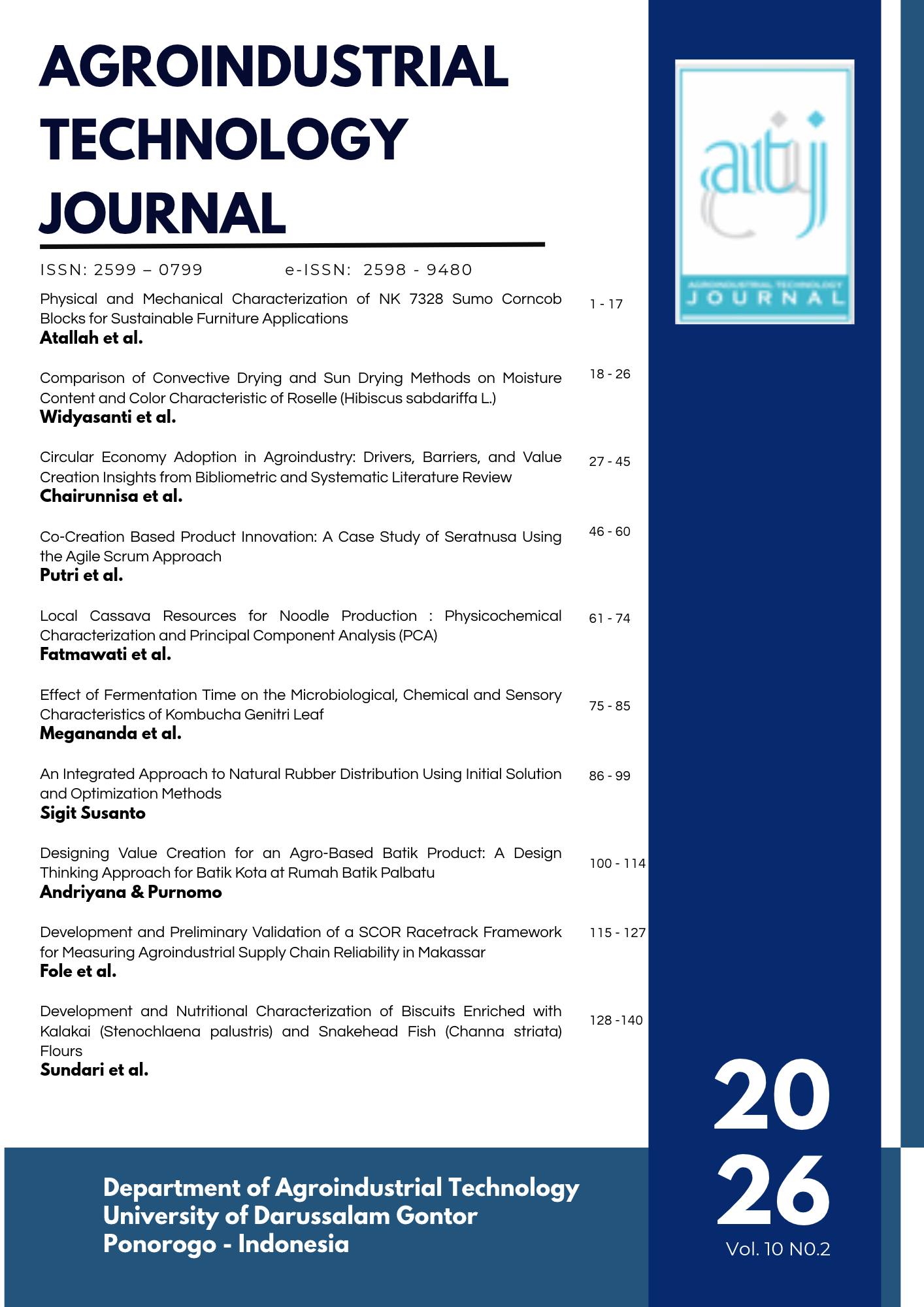
Physical and Mechanical Characterization of NK 7328 Sumo Corncob Blocks for Sustainable Furniture Applications
DOI:
https://doi.org/10.21111/atj.v10i2.31Keywords:
NK 7328 Sumo Corncob Block, physical characterization, mechanical characterization anisotropy, sustainable furnitureAbstract
NK 7328 Sumo corncob block is abundant agricultural residue with potential as a renewable lignoselulosic biomaterial for sustainable furniture applications. However comprehensive physical and mechanical chracterization of corncob block has not been investigated yet. This study aimed to characterize the physical and mechanical properties of NK 7328 Sumo corncob blocks, including dimensions, mass, density, and moisture content. Mechanical testing via compression test (parallel and perpendicular to the structure) and three-point bending test was conducted using a Universal Testing Machine and supporting manual compression test. The results indicated that corncob blocks possess low density, moderate moisture content, and relatively uniform dimensions, reflecting their lightweight lignoselulosic nature. Mechanical testing revealed anistropic behavior, with average compressive stresses of 7.41 ± 1.52 MPa (parallel) and 17.04 ± 4.48 Mpa (perpendicular). The coresponding compressive modulus of elasticity was 225.31 ± 33.32 MPa (parallel) and 104.57 ± 19.14 MPa (perpendicular), respectively. The average flexural stress was 6.75 ± 0.42 MPa with a flexural modulus of elasticity of 365.87 ± 88.17 MPa. These properties were includid by NK 7328 Sumo corncob block’s porosity, anisotropy, and internal heterogeneity. This findings sugest that NK 7328 Sumo corncob are suitable for lightweight, non-structural, semi-functional, and decorative furniture components, although their mechanical strength and stiffness limit their use in primary load-bearing applications.
References
Ait Benhamou, A., Calvez, I., & Landry, V. (2026). Evaluating the effects of Kraft and Hydroxymethylated lignin on particleboard performance and environmental impact. International Journal of Adhesion and Adhesives, 146.https://doi.org/10.1016/j.ijadhadh.2025.104249
Akinyemi, A. B., Afolayan, J. O., & Ogunji Oluwatobi, E. (2016). Some properties of composite corn cob and sawdust particle boards. Construction and Building Materials, 127, 436–441. https://doi.org/10.1016/j.conbuildmat.2016.10.040
Alfi Zaini Amrillah, N., Hanum, F. F., Rahayu, A., BalqisViratu Hapsari, A., & Nuraini, N. (2024). Potential Utilization of Cocoa Waste from Gunung Kidul Cocoa Fermentation Center: The Influence of NaOCl in Cellulose Extraction from Cocoa Pod Husk. Agroindustrial Technology Journal, 8(1), 10–19. https://doi.org/10.21111/atj.v8i1.11275
Astari, L., Belleville, B., Umemura, K., Filkov, A., Ozarska, B., & Crawford, R. H. (2024). Determination of Physical, Mechanical and Fire Retardancy Properties of Innovative Particleboard Made from Corn Stalk (Zea mays L.) Particles. Journal of Renewable Materials, 12(10), 1729–1756. https://doi.org/10.32604/jrm.2024.054786
Choi, J. Y., Nam, J., Yun, B. Y., Kim, Y. U., & Kim, S. (2022). Utilization of corn cob, an essential agricultural residue difficult to disposal: Composite board manufactured improved thermal performance using microencapsulated PCM. Industrial Crops and Products, 183. https://doi.org/10.1016/j.indcrop.2022.114931
Dauletbek, A., Li, H., Lorenzo, R., Corbi, I., Corbi, O., & Ashraf, M. (2022). A review of basic mechanical behavior of laminated bamboo lumber. In Journal of Renewable Materials (Vol. 10, Number 2, pp. 273–300). Tech Science Press. https://doi.org/10.32604/jrm.2022.017805
Deng, K., Huang, L., Jiang, N., & A, X. (2025). Mechanical properties and pore structures of sodium silicate modified corn cob cement mortar. Construction and Building Materials, 503. https://doi.org/10.1016/j.conbuildmat.2025.144513
Fitri, H., Gürdil, G. A. K., Demirel, B., Cevher, E. Y., & Roubík, H. (2023). Biomass potential from agricultural residues for energy utilization in West Nusa Tenggara (WNT), Indonesia. GCB Bioenergy, 15(11), 1405–1414. https://doi.org/10.1111/gcbb.13100
Food and Agriculture Organization of the United Nations. (2024, December 20). Agricultural production statistics 2010–2023. FAO Statistics.
Fouly, A., Abdo, H. S., Seikh, A. H., Alluhydan, K., Alkhammash, H. I., Alnaser, I. A., & Abdo, M. S. (2021). Evaluation of mechanical and tribological properties of corn cob-reinforced epoxy-based composites—theoretical and experimental study. Polymers, 13(24). https://doi.org/10.3390/polym13244407
Gairola, S., Naik, T. P., Sinha, S., & Singh, I. (2022). Corncob waste as a potential filler in biocomposites: A decision towards sustainability. Composites Part C: Open Access, 9. https://doi.org/10.1016/j.jcomc.2022.100317
Hanifah, A., Sumirat, R., Soerya, S. F., & Aristri, M. A. (2025). Isolation and Characterization of Cellulose from Biomass: A Methodological Review. Agroindustrial Technology Journal, 9(1), 15–33. https://doi.org/10.21111/atj.v9i1.14568
Louis, A. C. F., & Venkatachalam, S. (2020). Energy efficient process for valorization of corn cob as a source for nanocrystalline cellulose and hemicellulose production. International Journal of Biological Macromolecules, 163, 260–269. https://doi.org/10.1016/j.ijbiomac.2020.06.276
Maqsood, S., Navaf, M., Kumar, P., Yücetepe, A., Trang Thuy, N. N., Ozkan, G., Moreno, A., Capanoglu, E., Khalid, W., & Esatbeyoglu, T. (2025). Sustainable utilization of corn waste and their role toward the circular economy. In Journal of Agriculture and Food Research (Vol. 23). Elsevier B.V. https://doi.org/10.1016/j.jafr.2025.102165
Marcuello, C., Foulon, L., Chabbert, B., Aguié-Béghin, V., & Molinari, M. (2020). Atomic force microscopy reveals how relative humidity impacts the Young’s modulus of lignocellulosic polymers and their adhesion with cellulose nanocrystals at the nanoscale. International Journal of Biological Macromolecules, 147, 1064–1075. https://doi.org/10.1016/j.ijbiomac.2019.10.074
Nkomo, N. Z., & Alugongo, A. A. (2025). Development and Characterization of a Corn Cob Particulate/Polyester Resin Composite for Use as a Particle Board. SSRG International Journal of Mechanical Engineering, 12(3), 71–77. https://doi.org/10.14445/23488360/IJME-V12I3P106
Okeke, F. O., Ahmed, A., Imam, A., & Hassanin, H. (2024). A review of corncob-based building materials as a sustainable solution for the building and construction industry. In Hybrid Advances (Vol. 6). Elsevier B.V. https://doi.org/10.1016/j.hybadv.2024.100269
Pinto, J., Cruz, D., Paiva, A., Pereira, S., Tavares, P., Fernandes, L., & Varum, H. (2012). Characterization of corn cob as a possible raw building material. Construction and Building Materials, 34, 28–33. https://doi.org/10.1016/j.conbuildmat.2012.02.014
Pinto, J., Vieira, B., Pereira, H., Jacinto, C., Vilela, P., Paiva, A., Pereira, S., Cunha, V. M. C. F., & Varum, H. (2012). Corn cob lightweight concrete for non-structural applications. Construction and Building Materials, 34, 346–351. https://doi.org/10.1016/j.conbuildmat.2012.02.043
Putra, E. P. D. (2022). SIFAT FISIK DAN MEKANIK BIOPLASTIK DARI PATI KULIT PISANG AMBON (Musa paradisiacal) DENGAN PLASTICIZER SORBITOL. Agroindustrial Technology Journal, 6(2), 164–174. https://doi.org/10.21111/atj.v6i2.7819
Rahmatullah, R., Putri, R. W., Nurisman, E., Yandriyani, Y., Al Hadi, A., & Raihan, M. A. (2024). Manufacturing Biodegradable Bioplastics from A Mixture of Starch and Kapok Fibers with Variations of Chitosan and Glycerol. Agroindustrial Technology Journal, 8(1), 60–76. https://doi.org/10.21111/atj.v8i1.11086
Rahmatullah, R., Putri, R. W., Sufra, R., & Musyafa, M. F. (2025). A Study of Physical and Mechanical Properties: Durian Peel Starch-Sago Starch Biocomposite Bioplastic with Sorbitol Plasticizer Reinforced by Chitosan and Zinc Oxide. Agroindustrial Technology Journal, 9(2), 1–9. https://doi.org/10.21111/atj.v9i2.14928
Ramos, A., Briga-Sá, A., Pereira, S., Correia, M., Pinto, J., Bentes, I., & Teixeira, C. A. (2021). Thermal performance and life cycle assessment of corn cob particleboards. Journal of Building Engineering, 44, 102998. https://doi.org/10.1016/J.JOBE.2021.102998
Takada, M., Niu, R., Minami, E., & Saka, S. (2018). Characterization of three tissue fractions in corn (Zea mays) cob. Biomass and Bioenergy, 115, 130–135. https://doi.org/10.1016/j.biombioe.2018.04.023
Xia, G., Yu, S., Yang, Z., Lian, J., Xie, Y., & Feng, Q. (2024). Reconstructed wood with high water stability from bark cellulose and corncob lignin. International Journal of Biological Macromolecules, 281. https://doi.org/10.1016/j.ijbiomac.2024.136187
Xu, C., van Blokland, J., Mota, I. F., Alao, P., Daniel, G., & Adamopoulos, S. (2025). Use of secondary fibres from recycling processes of fibreboard manufacturing and post-consumer waste in medium density fibreboard. European Journal of Wood and Wood Products, 83(5). https://doi.org/10.1007/s00107-025-02323-y
Zou, Y., Fu, J., Chen, Z., & Ren, L. (2021). The effect of microstructure on mechanical properties of corn cob. Micron, 146. https://doi.org/10.1016/j.micron.2021.103070
Electronic Publication
[BSN] Badan Pusat Statistik. (2025, February 3). Pada 2024, luas panen jagung pipilan mencapai 2,55 juta hektare, produksi jagung pipilan kering dengan kadar air 14 persen pada 2024 sebanyak 15,14 juta ton.
[BSN] Badan Standardisasi Nasional. (2000). SNI 01-5008.2-2000: Kayu lapis penggunaan umum. Badan Standardisasi Nasional.
[BSN] Badan Standardisasi Nasional. (2002). SNI 01-5008.12-2002: Produk kayu olahan, Bagian 12: Papan blok penggunaan umum. Badan Standardisasi Nasional.
[BSN] Badan Standardisasi Nasional. (2006a). SNI 01-7201-2006: Kayu lapis dan papan blok bermuka kertas indah. Badan Standardisasi Nasional.
[BSN] Badan Standardisasi Nasional. (2006b). SNI 03-2105-2006: Papan partikel. Badan Standardisasi Nasional.
[ECS] European Committee for Standardization. (2010). EN 312:2010 Particleboards: Specifications. European Committee for Standardization.
[FAO] Food and Agriculture Organization of the United Nations. (2024, December 20). Agricultural production statistics 2010–2023. FAO Statistics.
Unibois. (2025). Particleboard P2: Technical data sheet. Unibois. https://unibois.net/wp-content/uploads/2025/09/Particle-Board-P2_compressed.pdf
Downloads
Submitted
Accepted
Published
How to Cite
Issue
Section
License
Copyright (c) 2026 Agroindustrial Technology Journal

This work is licensed under a Creative Commons Attribution-NonCommercial-ShareAlike 4.0 International License.
The author whose published manuscript approved the following provisions:
1. The right of publication of all material published in the journal / published in the Agroindustrial Technology Journal is held by the editorial board with the knowledge of the author (moral rights remain the author of the script).
2. The formal legal provisions for access to digital articles of this electronic journal are subject to the terms of the Creative Commons Attribution-NonCommercial-ShareAlike 4.0 International License (CC BY-NC-SA 4.0), which means that Agroindustrial Technology Journal reserves the right to save, transmit media or format, Database), maintain, and publish articles without requesting permission from the Author as long as it keeps the Author's name as the owner of Copyright.
3. Printed and electronically published manuscripts are open access for educational, research and library purposes. In addition to these objectives, the editorial board shall not be liable for violations of copyright law.