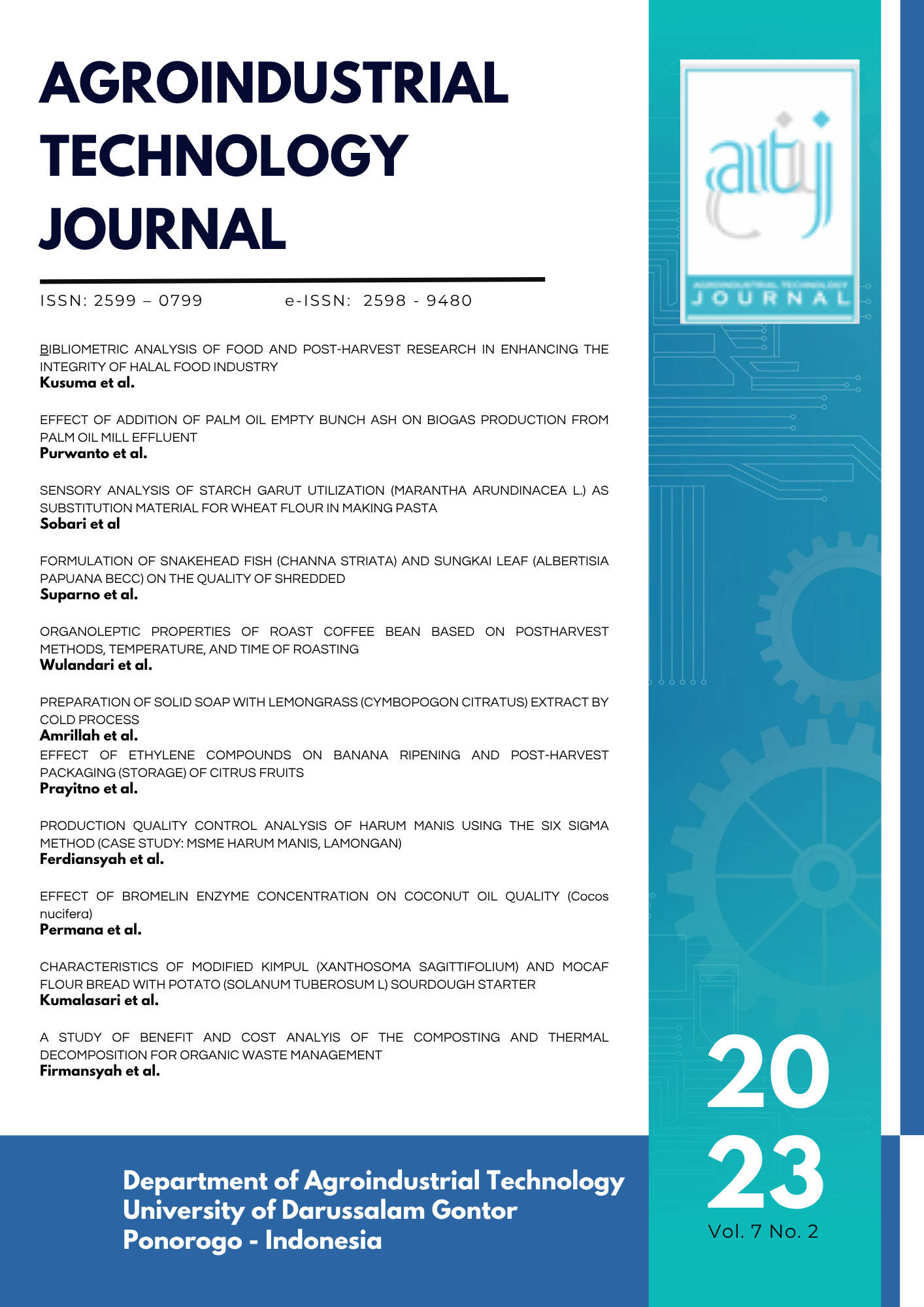
Effect of Addition of Palm Oil Empty Bunch Ash on Biogas Production from Palm Oil Mill Effluent
Keywords:
Palm oil mill effluent (POME), Empty palm fruit bunches (EPFB), Biogas, Methane gasAbstract
Palm oil mill effluent (POME) and empty palm fruit bunches (EPFB) are the waste with the largest amount of capacity resulting from the processing of the palm oil industry. POMEhas a high organic content that can be used as a biogas producer. This study used POME, EFB and cow dung as ingredients to produce biogas using an anaerobic batch digester with a volume of 20 liters, where each experiment had a different material composition and the addition of a different concentration of tankos ash solution. The purpose of this study was to determine the appropriate concentration of mixing a solution of tankos ash, POME, and cow dung in an effort to increase biogas production. The results showed that from several experiments that had been carried out during 30 days of observation, the experiment that had the highest value of biogas production and methane gas revenue was the experiment with a composition of 5 liters of cow dung, 5 liters of POMEand 10 liters of tankos ash solution (1:1:2) has a biogas production value of 58,646 ml and CH4 methane gas revenue of70.1%. It was concluded that the addition of tankos ash solution can significantly increase the pH of the waste digester and can increase the amount of biogas production with a certain concentration
References
Ceron Vivas, A., Caceres, K. T., Rincon, A., & Cajigas, A. A. (2019).Influence of pH and the C/N ratio on the biogas production of wastewater. Revista Facultad de Ingeniería Universidad de Antioquia, (92), 70-79.DirektoratJenderal Perkebunan. (2019). Statistik Perkebunan Indonesia. Kelapa Sawit.Direktorat Jenderal Perkebunan.Jakarta.Garritano, A. N., de Oliveira Faber, M., De Sa, L. R., & FerreiraLeitao, V. S. (2018). Palm oil mill effluent (POME) as raw material for biohydrogen and methane production via dark fermentation. Renewable andSustainable Energy Reviews, 92, 676-684.Hanum, F., Tambun, R., Ritonga, M. Y., & Kasim, W. W. (2015). Aplikasi elektrokoagulasi dalam pengolahan limbah cair pabrik kelapa sawit.Jurnal Teknik Kimia USU,4(4), 13-17.Haryanto,A., Sugianti, C., Triyono, S., & Apria, N. E. (2018). Biogas production from oil palm empty fruit bunches through dry fermentation process.Preliminary Results.Hasanudin, U., Sugiharto, R., Haryanto, A., Setiadi, T., & Fujie, K. (2015). Palm oil mill effluent treatment and utilization to ensure the sustainability of palm oil industries. Water science and technology, 72(7), 1089-1095.
Irvan,B. Trisaksti, V. Wongistani, &Y. Tomiuchi. (2012). Methane Emission from digestion of palm oil mill effluent(POME)in thermophilic anaerobic reactor. International Journal of Science and Engineering. 3: 32-35.Mujdalipah, S., S. Dohong, A. Suryani, &A. Fitria. (2014). Pengaruh waktu fermentasi terhadap produksi biogas menggunakan digester dua tahap pada berbagai konsentrasi Palm Oil Mill Effluent (POME) dan lumpur aktif. AGRITECH. 34: 56-64.Mustafa,M. Y., Calay, R. K., & Roman, E. (2016). Biogas from organic waste-a case study. Procedia Engineering, 146, 310-317.Nisrina, H., & Andarani, P. (2018). Pemanfaatan limbah tahu skala rumah tangga menjadi biogas sebagai upaya teknologi bersih di laboratorium pusat teknologi lingkungan–BPPT.Jurnal Presipitasi: Media Komunikasi dan Pengembangan Teknik Lingkungan, 15(2), 139-147.Rajani,A., Santosa, A., Saepudin, A., Gobikrishnan, S., & Andriani, D. (2019). Review on biogas from palm oil mill effluent (POME): challenges and opportunities in Indonesia. In IOP Conference Series: Earth and Environmental Science.293: 1-12.Rizal, T. A., Mahidin, M., & Ayyub, M. (2015). Pengembangan anaerobic digester untuk produksi biogas dari limbah cair pabrik kelapa sawit.Jurnal Umum Teknik Terapan, 2(02), 8-27.Rusdiyono,A. P., Kirom, M. R., & Qurthobi, A. (2017). Perancangan Alat Ukur Konsentrasi Gas Metan Dari Anaerobic Baffled Reactor (abr) Semi-kontinyu Dengan Substrat Susu Basi. eProceedings of Engineering, 4(1).Sompong,O., Boe, K., & Angelidaki, I. (2012). Thermophilic anaerobic co-digestion of oil palm empty fruit bunches with palm oil mill effluent for efficient biogas production. Applied Energy, 93, 648-654.Widarti, B. N., Susetyo, S. H., & Sarwono, E. (2015). Degradasi COD limbah cair dari pabrik kelapa sawit dalam proses pembentukan biogas. Jurnal Integrasi Proses, 5(3).Warsito,J., Sabang, S. M., & Mustapa, K. (2016). Pembuatan pupuk organik dari limbah tandan kosong kelapa sawit. Jurnal Akademika Kimia, 5(1), 8-15.
Downloads
Submitted
Published
How to Cite
Issue
Section
License
Copyright (c) 2023 Agroindustrial Technology Journal

This work is licensed under a Creative Commons Attribution-NonCommercial-ShareAlike 4.0 International License.
The author whose published manuscript approved the following provisions:
1. The right of publication of all material published in the journal / published in the Agroindustrial Technology Journal is held by the editorial board with the knowledge of the author (moral rights remain the author of the script).
2. The formal legal provisions for access to digital articles of this electronic journal are subject to the terms of the Creative Commons Attribution-NonCommercial-ShareAlike 4.0 International License (CC BY-NC-SA 4.0), which means that Agroindustrial Technology Journal reserves the right to save, transmit media or format, Database), maintain, and publish articles without requesting permission from the Author as long as it keeps the Author's name as the owner of Copyright.
3. Printed and electronically published manuscripts are open access for educational, research and library purposes. In addition to these objectives, the editorial board shall not be liable for violations of copyright law.