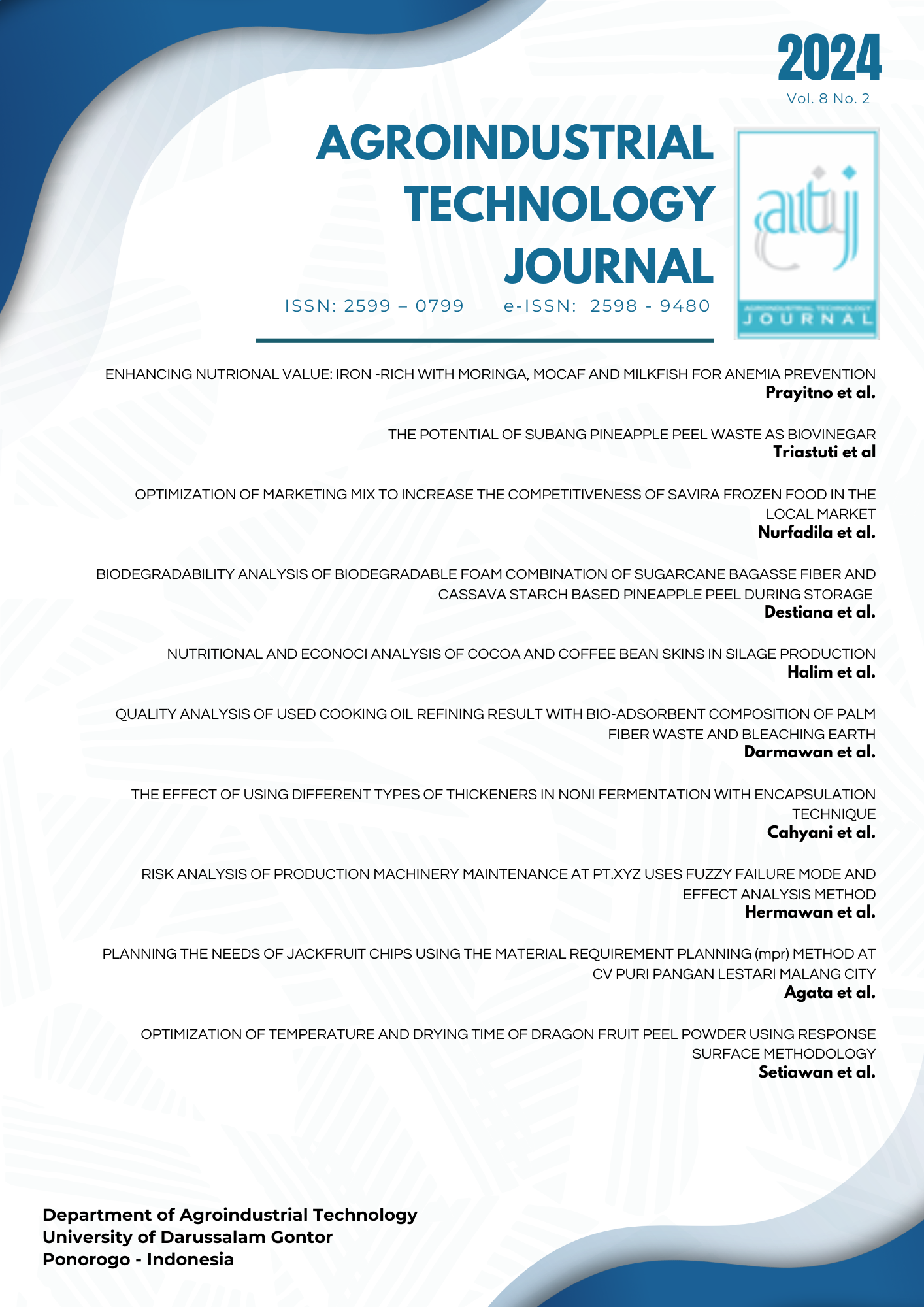
Optimization of Temperature and Drying Time of Dragon Fruit Peel Powder Using Response Surface Methodology
Keywords:
Dragon fruit peel, Drying, Powder, RSMAbstract
Dragon fruit is one of the fruits that has high economic value with good cultivation prospects in Indonesia, making it one of the most recommended by many people because it contains lots of vitamins. Dragon fruit skin has many benefits but has not been utilized optimally.Post-harvesthandlingeffortsneedtobedonetoextendthe shelf life of dragon fruit skin,onewaythatcanbedoneisthroughthedryingprocesstoreducewater content so that it can inhibit microbial growth and have a longer shelf life. The purpose of this study is to determine the effect of combination temperature and drying time, water content, color and organoleptic of dragon fruit skin powder. Optimization of temperature and drying time was analyzed using Response Surfase Methodology (RSM) at temperatures of 60°C, 70°C and 80°Cwith 5-, 6-, and 7-hours duration. Results showed that the optimal temperature for drying processofdragonfruitskinwasatatemperatureof79.47°Cwith5hoursduration.Theoptimal yield produced at the best temperature and drying time was 16,09% with a water content of 4.63%. In the color test of sample with combination temperature 600C and 6 hours duration showed the highest brightness of 65.6 and the results of the organoleptic test showed that temperature and drying time had a significant effect on the color and aroma of dragon fruit skin powder
References
Analianasari, & Zaini, M. (2018). PemanfaatanJagungManisDanKulit BuahNagaUntukOlahanMieKering Kaya Nutrisi. Jurnal Penelitian 2,32,032,832,53,12,52,632,732,733,172,732,532,530123412345678910111213Rata-Rata Sampel Pertanian Terapan, 16(2), 123–131.Apriani, P., Marcellia, S., & Nofita. (2023). Uji Aktivitas Antijamur Ekstrak Etanol Kulit Buah Mahoni (Swietenia mahagoni L.) Terhadap Candida albicans. Analytical and Environmental Chemistry,8(01),1-10.Badan Pusat Statistik. (2022). Statistik Pertanian Holtikultura Provinsi Jawa Timur.Bunardi, C. (2016). Kualitas Minuman Serbuk Daun Sirsak (Annona muricata) Dengan Variasi Konsentrasi Maltodekstrin dan Suhu Pemanasan. Jurnal Teknobiologi, 1, 1–18.Enjelina, W., Rilza, Y. O., & Erda, Z. (2019). Pemanfaatan kulit buah naga merah (Hylocereus polyrhizus sp.) untuk memperpanjang umur simpan mie basah. AcTion: Aceh Nutrition Journal,4(1),63.https://doi.org/10.30867/action.v4i1.162Fauzi,R.A.,Widyasanti,A.,Perwitasari,S.D. N., & Nurhasanah, S. (2022). Optimasi ProsesPengeringan Terhadap AktifitasAntioksidanBungaTelang (Clitoriaternatea)Menggunakan MetodeResponPermukaan.Jurnal TeknologiPertanian,23(1),9–22. https://doi.org/10.21776/ub.jtp.2022.02 3.01.2Kusuma, H. A. W., Kumalaningsih, S., & Pranowo, D. (2019). Optimasi Suhu dan Konsentrasi Maltodekstrin pada Proses Pembuatan Serbuk Lobak dengan Metode Foam Mat Drying. Industria: Jurnal Teknologi Dan ManajemenAgroindustri,8(3),171-182.https://doi.org/10.21776/ub.industria.2019.008.03.2Kusumawati, Candra, E., Pramono, Y. B., &Hintono,A.(2017).SifatFisikTepung Kulit Buah Naga Merah Pada Pengeringan Matahari dan Oven Dengan Penutupan Kain Hitam. In Skripsi Program Studi S1 Teknologi pangan Undip.Lubis, A. W., & Harahap, D. N. (2018). Pemanfaatan Sari Buah Naga Super Merah (Hylocereus costaricensis) Pada Pembuatan Nata De Coco TerhadapMutu FisikNata. Journal of Chemistry, Education, and Science, 2(2), 1–10.Musyofa, F., Supriyanto, & FM, M. F. (2022). Aktivitas Antioksidan dan SifatSensorisStikBuahNagaMerah(HylocereusPolyrhizus).Agroindustrial Technology Journal, 6(2),1-17.https://doi.org/10.21111/atj.v6i2.7707Paramita, V. D., Rosalin, Y. H., Nuhaida,S.,&Novemby,P.(2022).AspekFisikdanKimiaMikrokapsulEkstrak Daun Kelor. Prosiding 6th Seminar Nasional Penelitian & Pengabdian KepadaMasyarakat 2022ASPEK, 1-6.Pramudya,P.A.,Fahmi,A.S.,&Rianingsih,L. (2022). Optimasi Suhu dan Waktu Pengeringan Nori Berbahan Baku UlvalactucadanGelidiumSp.dengan Penambahan Perisa Bubuk Kepala Udang MenggunakanResponse SurfaceMethodology.JurnalIlmudanTeknologiPerikanan,4(2),100109.https://doi.org/10.14710/jitpi.2022.13780Rahman, S. (2018). Buku Teknologi Pengolahan Tepung dan Pati Biji-Bijian Berbasis Tanaman Kayu.Rochmawati, N. (2019). Utilization of Red Dragon Fruit (Hylocereus polyrhizus) Peel as Flour for Making Cookies. Jurnal Pangan Dan Agroindustri, 7(3), 19–24.Sarofatin,A.,&Wahyono,A.(2018). PengaruhSuhuPengeringan TerhadapKarakteristikKimiadan AktivitasAntioksidanBubukKulit Buah Naga Merah. June. https://doi.org/10.25047/agropross.201 8.66Slamet, A. H. H., Mutmaidah, D. N., Rizqullah, R., & Apriani, F. (2022). Analisis Nilai Tambah dan Strategi Pengembangan Industri Olahan Kulit Buah Naga di Kabupaten Banyuwangi, Jawa Timur. Food Scientia:JournalofFoodScienceand Technology, 2(1), 20–47.https://doi.org/10.33830/fsj.v2i1.2686.2022Styaningrum,S.D.,Sari,P.M.,Puspaningtyas,D.E.,Nidyarini, A., & Anita, T. F. (2023). Analisis Warna, Tekstur, Organoleptik Serta KesukaanPadaKukisGrowolDenganVariasiPenambahanInulin. Ilmu Gizi Indonesia,6(2),115. https://doi.org/10.35842/ilgi.v6i2.406Trisyani,N.,Agustin,T.I.,&Ningrum,R. H. (2021). Karakteritik Fisik dan Organoleptik Tepung Daging Kerang Bambu (Solen sp.) Dengan Bahan Perendam yang Berbeda. Jurnal Kelautan: Indonesian Journal of Marine Science and Technology, 14(1)82-90.https://doi.org/10.21107/jk.v14i1.10386Wardani,K.K.,Nisa,N.I.F.,Setiawan,M.A.,&Ningsih,E.(2023).StudiPengaruhSuhuTerhadapMoistureContentdan DryingRatePorang (AmorphophallusOncophyllus)MenggunakanTrayDryer.AgroindustrialTechnologyJournal, 7(3), 9–18.Wulansari,D.,Rahmi,S.L.,Fiardilla,F.,& Ningsih, S. (2023). Uji Organoleptik MinumanSerbukEffervescentDanu Pulai (Alstonia scholaris (L.) R.BR.). JurnalPengembanganAgroindustri Terapan,2(1),20–29. https://doi.org/10.25181/jupiter.v2i1. 2878Yulni, T., Lekutsi, W. P., & Ummah, N. (2023). Model Kinetika Pengeringan ManisanMangga (Mangifera indica L.).AgroindustrialTechnologyJournal,7(1),41–51.
Downloads
Submitted
Published
How to Cite
Issue
Section
License
Copyright (c) 2024 The Author (s)

This work is licensed under a Creative Commons Attribution-NonCommercial-ShareAlike 4.0 International License.
The author whose published manuscript approved the following provisions:
1. The right of publication of all material published in the journal / published in the Agroindustrial Technology Journal is held by the editorial board with the knowledge of the author (moral rights remain the author of the script).
2. The formal legal provisions for access to digital articles of this electronic journal are subject to the terms of the Creative Commons Attribution-NonCommercial-ShareAlike 4.0 International License (CC BY-NC-SA 4.0), which means that Agroindustrial Technology Journal reserves the right to save, transmit media or format, Database), maintain, and publish articles without requesting permission from the Author as long as it keeps the Author's name as the owner of Copyright.
3. Printed and electronically published manuscripts are open access for educational, research and library purposes. In addition to these objectives, the editorial board shall not be liable for violations of copyright law.