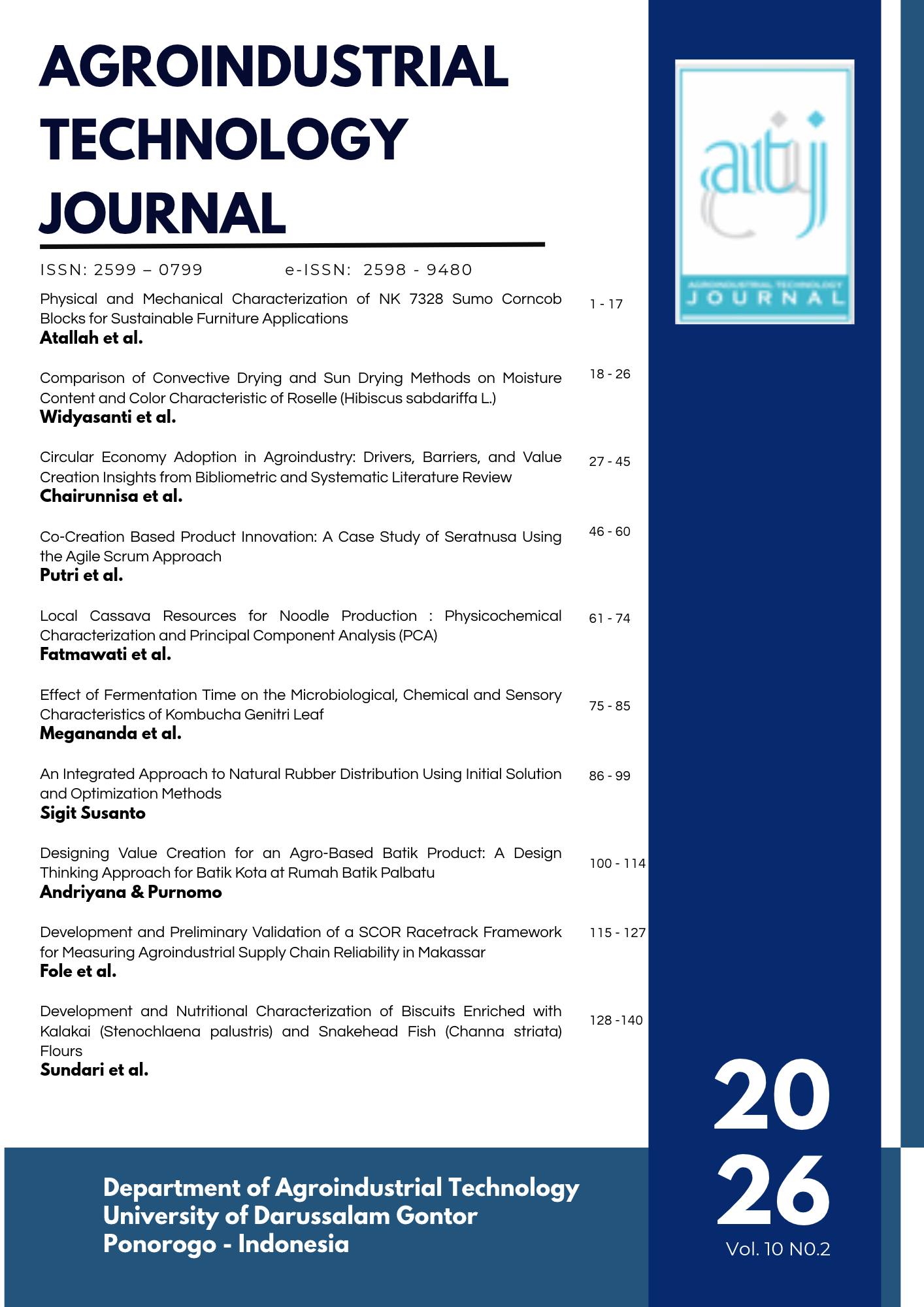
Development and Preliminary Validation of a SCOR Racetrack Framework for Measuring Agroindustrial Supply Chain Reliability in Makassar
DOI:
https://doi.org/10.21111/atj.v10i2.154Keywords:
Agroindustry, Analytical Hierarchy Process, Reliability, SCOR Racetrack, Supply Chain PerformanceAbstract
Agroindustrial supply chains require reliable performance to ensure timely delivery, product quality, and accurate order fulfillment. This study aims to develop a SCOR Racetrack-based framework for measuring and prioritizing supply chain Reliability in small- and medium-scale agroindustrial enterprises in Makassar, Indonesia. A descriptive case-study approach was adopted, integrating supply chain mapping, SCOR Digital Standard 14.0, expert-based KPI screening, and hierarchical Analytical Hierarchy Process (AHP). The initial identification covered 60 Level-3 Reliability metrics, of which 33 were considered potentially applicable. An illustrative five-expert Likert assessment, representing three academics and two practitioners, provisionally retained 20 KPIs comprising 10 customer-related, eight supplier-related, and two return-related indicators. Hierarchical AHP calculations produced Level-1 priority weights of 0.5830 for customer fulfillment, 0.3119 for supplier fulfillment, and 0.1051 for return fulfillment. Customer Commit Date Achievement (RL.3.3) obtained the highest global weight (0.0993), followed by RL.3.10 and RL.3.12 (0.0875 each). The maximum aggregated Consistency Ratio was 0.0041, while sensitivity analysis indicated stable leading priorities across the examined scenarios. The proposed framework integrates SCOR processes with hierarchical Reliability indicators to support performance measurement and managerial prioritization. Further verification using original expert judgments and operational data is required to establish empirical validity, consistent with the preliminary proof-of-concept objectives of Technology Readiness Level 3.
References
Association for Supply Chain Management. (2022). Supply Chain Operations Reference model: SCOR Digital Standard (Version 14.0). https://scor.ascm.org
Badan Pusat Statistik Kota Makassar. (2026). Produksi buah-buahan dan sayuran tahunan menurut jenis tanaman di Kota Makassar, 2025. https://makassarkota. bps.go.id/id/statistics-table/3/WXpSVU 5uUTBOSEl5WVhGQmVESTVSVnBSVlhWeVVUMDkjMw==/produksi-buahbuahan-dan-sayuran-tahunan-menurut-jenis-tanaman-di-kota-makassar--2019.html
Baladraf, T. T. (2024). Analysis of agro-industry supply chain performance on organic rice in Jember Regency. Agroindustrial Journal, 11(2), 72–88. https://doi.org/10.22146/aij.v11i2.99299
Dou, R., Liu, X., Hou, Y., & Wei, Y. (2024). Mitigating closed-loop supply chain risk through assessment of production cost, disruption cost, a nd reliability. International Journal of Production Economics, 270, Article 109174. https://doi.org/10.1016/j.ijpe.2024.109174
Fole, A., Immawan, T., Kusrini, E., Mail, A., & Dahlan, M. (2024). Gap Analysis And Enhancement Strategy For Supply Chain Performance In The Handicraft Industry of ISR Bone SMES: A SCOR Racetrack Approach. Journal of Industrial Engineering Management, 9(3), 23-32. http://dx.doi.org/10.33536/jiem.v9i3.1865
Fole, A., Safitri, K. N., 'Aini, N., Syufrian, B., & Riana, R. I. (2026). Evaluating supply chain resilience strategies in passion fruit agro-industrial processing using the SCOR 14.0 Racetrack framework. Agroindustrial Technology Journal, 10(1), 29–42. https://doi.org/10.21111/ atj.v10i1.17
Gupta, S., Chatterjee, P., Rastogi, R., & Santibañez-González, E. D. R. (2023). A Delphi fuzzy analytic hierarchy process framework for criteria classification and prioritization in food supply chains under uncertainty. Decision Analytics Journal, 7, Article 100217. https://doi. org/10.1016/j.dajour.2023.100217
Ivo de Carvalho, M., Relvas, S., & Barbosa-Póvoa, A. P. (2022). A roadmap for sustainability performance assessment in the context of agri-food supply chain. Sustainable Production and Consumption, 34, 565–585. https://doi. org/10.1016/j.spc.2022.10.001
Kusrini, E., Helia, V. N., Miranda, S., & Asshiddiqi, F. (2023). SCOR Racetrack to improve supply chain performance. Mathematical Modelling of Engineering Problems, 10(3), 915–920. https://doi.org/10.18280/mmep.100322
Kusrini, E., Safitri, K. N., & Fole, A. (2020, November). Design key performance indicator for distribution sustainable supply chain management. In 2020 International Conference on Decision Aid Sciences and Application (DASA) (pp. 738-744). IEEE. https://doi.org/ 10.1109/DASA51403.2020.9317289
Lestari, E., Asdar, M., Indrabayu, & Mahmudin, F. (2025). Container layout design (modelling) to optimise the function of Makassar New Port in the economic development of Makassar City. Journal Européen des Systèmes Automatisés, 58(9), 1777–1784. https://doi.org/10.18280/jesa.580901
Manikas, I., Sundarakani, B., Anastasiadis, F., & Ali, B. (2022). A framework for food security via resilient agri-food supply chains: The case of UAE. Sustainability, 14(10), Article 6375. https://doi.org/10.3390/su14106375
Mishra, R., Singh, R. K., & Subramanian, N. (2022). Impact of disruptions in agri-food supply chain due to COVID-19 pandemic: Contextualised resilience framework to achieve operational excellence. The International Journal of Logistics Management, 33(3), 926–954. https://doi.org/10.1108/IJLM-01-2021-0043
Mu, W., van Asselt, E. D., & van der Fels-Klerx, H. J. (2021). Towards a resilient food supply chain in the context of food safety. Food Control, 125, Article 107953. https://doi.org/10.1016/ j.foodcont.2021.107953
Nguyen, T. T. H. (2024). Measuring supply chain performance using the SCOR model. Operations Research Forum, 5, Article 37. https://doi.org/10.1007/ s43069-024-00314-y
Özkanlısoy, Ö., & Bulutlar, F. (2023). Measuring supply chain performance as SCOR v13.0-based in disruptive technology era: Scale development and validation. Logistics, 7(3), Article 65. https://doi.org/10.3390/logistics7030065
Ramos, E., Coles, P. S., Chavez, M., & Hazen, B. (2022). Measuring agri-food supply chain performance: Insights from the Peruvian kiwicha industry. Benchmarking: An International Journal, 29(5), 1484–1512. https://doi. org/10.1108/BIJ-10-2020-0544
Reklitis, P., Sakas, D. P., Trivellas, P., & Tsoulfas, G. T. (2021). Performance implications of aligning supply chain practices with competitive advantage: Empirical evidence from the agri-food sector. Sustainability, 13(16), Article 8734. https://doi.org/10.3390/su13168734
Rodríguez Mañay, L. O., Guaita-Pradas, I., & Marques-Perez, I. (2022). Measuring the supply chain performance of the floricultural sector using the SCOR model and a multicriteria decision-making method. Horticulturae, 8(2), Article 168. https://doi.org/10.3390/ horticulturae8020168
Rosanti, N., Rahmalia, D., Sari, I. R. M., Tambunan, V. P., & Juniarti, R. (2025). Mengukur kinerja rantai pasok pada agroindustri tahu dan tempe: Aplikasi model Supply Chain Operations Reference (SCOR) [Measuring supply chain performance in tofu and tempeh agroindustry: An application of the SCOR model]. Jurnal Penelitian Pertanian Terapan, 25(1), 1–14. https://doi.org/10.25181/jppt.v25i1.3791
Saaty, T. L. (2008). Decision making with the analytic hierarchy process. International Journal of Services Sciences, 1(1), 83–98. https://doi.org/10.1504/IJSSCI.2008. 017590
Safitri, K. N., Fole, A., Aini, N., & Negara, P. P. S. (2025). Strategies for enhancing supply chain efficiency in the agricultural sector through the implementation of the SCOR Racetrack method. Agroindustrial Technology Journal, 9(1), 90–100. https://doi.org/10.21111/atj.v9i1.14299
Sharma, R., Kannan, D., Darbari, J. D., & Jha, P. C. (2024). Group decision making model for selection of performance indicators for sustainable supplier evaluation in agro-food supply chain. International Journal of Production Economics, 277, Article 109353. https://doi.org/10.1016/ j.ijpe.2024.109353
Silvia, E., Udin, F., Bantacut, T., & Marimin. (2024). Kinerja rantai pasok PT. X dalam upaya peningkatan keberlanjutan dan responsivitas agroindustri kelapa sawit. Agrointek, 18(2), 474–486. https://doi. org/10.21107/agrointek.v18i2.19341
Suryaningrat, I. B., Rusdianto, A. S., Amilia, W., Choiron, M., & Andriani, W. N. (2025). Pengukuran kinerja rantai pasok (supply chain) beras pada Pabrik Beras Sukoreno Makmur. Jurnal Agroindustri, 15(1), 68–82. https://doi.org/10.31186/ jagroindustri.15.1.68-82
Wardah, S., Marimin, Sudarwati, W., & Marfuah, U. (2023). Integration of SCOR and fuzzy AHP for location selection of edible white copra agro-industry. Jurnal Teknologi Industri Pertanian, 33(3), 216–227. https://doi.org/10.24961/j.tek.ind.pert.2023.33.3.216
Downloads
Submitted
Accepted
Published
How to Cite
Issue
Section
License
Copyright (c) 2026 Agroindustrial Technology Journal

This work is licensed under a Creative Commons Attribution-NonCommercial-ShareAlike 4.0 International License.
The author whose published manuscript approved the following provisions:
1. The right of publication of all material published in the journal / published in the Agroindustrial Technology Journal is held by the editorial board with the knowledge of the author (moral rights remain the author of the script).
2. The formal legal provisions for access to digital articles of this electronic journal are subject to the terms of the Creative Commons Attribution-NonCommercial-ShareAlike 4.0 International License (CC BY-NC-SA 4.0), which means that Agroindustrial Technology Journal reserves the right to save, transmit media or format, Database), maintain, and publish articles without requesting permission from the Author as long as it keeps the Author's name as the owner of Copyright.
3. Printed and electronically published manuscripts are open access for educational, research and library purposes. In addition to these objectives, the editorial board shall not be liable for violations of copyright law.