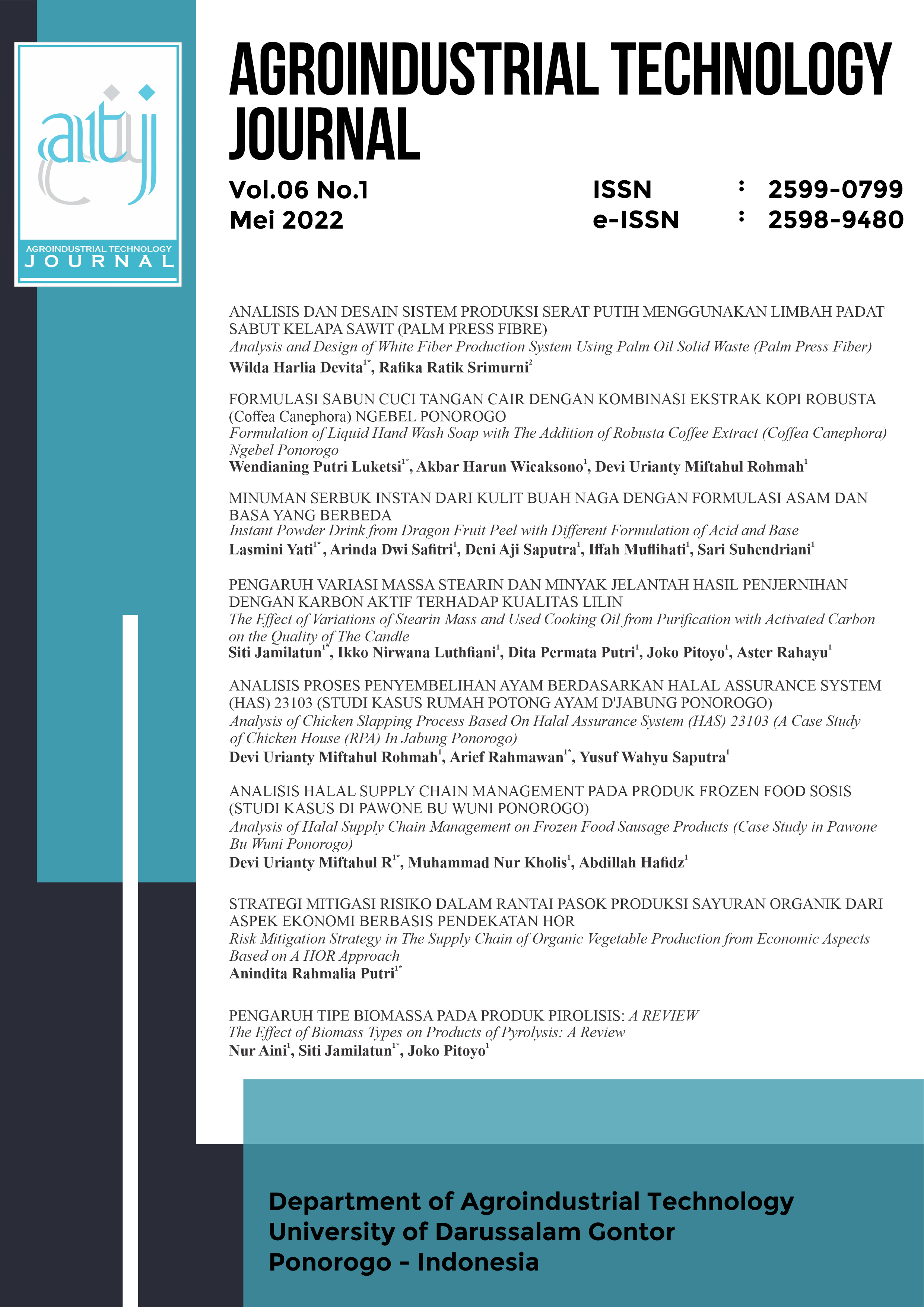
STRATEGI MITIGASI RISIKO DALAM RANTAI PASOK PRODUKSI SAYURAN ORGANIK DARI ASPEK EKONOMI BERBASIS PENDEKATAN HOR
Risk Mitigation Strategy in The Supply Chain of Organic Vegetable Production from Economic Aspects Based on A HOR Approach
Keywords:
economy, house of risk (HOR), indicators, mitigation, riskAbstract
Awareness of healthy food consumption has pushed the organic farming supply chain to further increase its productivity. This is not in line with the dynamic conditions of the organic farming supply chain. Dynamic conditions such as climate uncertainty, pest intervention to fluctuating market demand sometimes become obstacles for supply chain actors. In the organic farming supply chain, the production of organic vegetables poses the greatest risk and can disrupt the flow of products to consumers. These obstacles will directly cause losses for farmers. So to minimize these obstacles, a risk mitigation strategy design is needed. This study aims to design appropriate risk mitigation strategies in organic vegetable production. The research located in D.I Yogyakarta took respondent data consisting of farmers, CV owners, employees and experts in the field of organic agriculture. The focus of this research is the design of risk mitigation strategies from the economic aspect using the House of Risk (HOR) method on the production of organic vegetables from the organic farming supply chain. The results show that the source of risk that has the largest aggregate value is an uncertain climate with a value of 1701. And to minimize the potential for these risks, there are 12 mitigation strategies that can be applied. The risk mitigation strategy that has the highest rating with a value of 14850 is the existence of crop management that regulates the planting time between plants.
References
Amalia, Putri, Nurfitria H, Maeva A, and Elisa K. (2021). Risk Analysis in Halal Fast Food Supply Chain Restaurant Using Risk Map Method. International Journal of Mechanical Engineering Technologies and Applications. (9):61–66.
Cohen, Morris A, Hau LL. (2020). Designing the Right Global Supply Chain Network. Manufacturing and Service Operations Management. 22(1):15–24. DOI: 10.1287/msom.2019.0839.
Fauzi, Rahmat, Mahendradi RM. (2021). Pemberdayaan Pertanian Masyarakat Melalui Implementasi Program Kredit Usaha Rakyat. Jurnal Mahasiswa Administrasi Negara (JMAN). 5(1):30–51.
Hariyanti, Kharmila S, June T, Koesmaryono Y, Hidayat R, Pramudia A. (2020). Penentuan Waktu Tanam Dan Kebutuhan Air Tanaman Padi, Jagung, Kedelai Dan Bawang Merah Di Provinsi Jawa Barat Dan Nusa Tenggara Timur. Jurnal Tanah Dan Iklim. 43(1):83. DOI: 10.21082/jti.v43n1.2019.83-92.
Istiqomah, Asti, Nindyantoro, Novindra. (2019). Analisis Land Rent dan Daya Saing Pertanian Padi Organik Di Kabupaten Tasikmalaya. Journal of Agriculture, Resource and Environmental Economics. 2(1):13–25.DOI: 10.29244/jaree.v2i1.25929.
Karimi, Vahid, Karami E, Keshavarz M. (2018). Climate Change and Agriculture: Impacts and Adaptive Responses in Iran. Journal of Integrative Agriculture. 17(1):1–15. DOI: 10.1016/S2095-3119(17)61794-5.
Kurniawan M,Santoso I, and Kamal MA. (2019). Risk Management of Shallot Supply Chain Using Failure Mode Effect Analysis and Analytic Network Process (Case Study in Batu, East Java). IOP Conference Series: Earth and Environmental Science. 230(1). DOI: 10.1088/1755-1315/230/1/012055.
Nastis, Stefanos A, Mattas K, Baourakis G. (2019). Understanding Farmers’ Behavior towards Sustainable Practices and Their Perceptions of Risk. Sustainability. 11(5):1–13. DOI: 10.3390/su11051303.
Oktiarso T, Nadira AHK. (2019). Risk Mitigation for Agricultural Products Distribution in Agro-Business Terminal Mantung, Kabupaten Malang. IOP Conference Series: Materials Science and Engineering. 528(1). DOI: 10.1088/1757-899X/528/1/012087.
Ouattara, Pierre D, Eugene K, Aklesso YGE, Oluyele A. (2018). Climate Uncertainty and Agricultural Soil Conservation Investment Decisions. Climate Change Economics. 9(2):1–23. DOI: 10.1142/S2010007818500045.
Pagácová E, Duríková M, Catár G, Geislerová V, Brezányová J, Martanovic P, Braxatorisová T, Kúdelová K. (2018). Risks and Opportunities of Increasing Yields in Organic Farming. A Review. Agronomy for Sustainable Development . 38(14):1–21.
Pakdeenarong, Paveerat, Thammanoon H. (2020). Supply Chain Risk Management of Organic Rice in Thailand. Uncertain Supply Chain Management. 8(1):165–74. DOI: 10.5267/j.uscm.2019.7.007.
Saragi, Cyprianus PH, Mai FN, Maryanti S. (2021). Analisis Kinerja Agribisnis Padi Organik Di Kabupaten Pangandaran. Jurnal Agriust. Jurnal Agriust. 2(1):7–12.
Wojciech P, Cuthbertson R. (2015). Performance Measurement and Metrics in Supply Chains: An Exploratory Study. International Journal of Productivity and Performance Measurement. 64(8):1068–1091.
Zhao, Guoqing, Shaofeng L, Carmen L, Huilan C, Haiyan L, Sachin KM, Sebastian E. (2020). Risk Analysis of the Agri-Food Supply Chain: A Multi-Method Approach. International Journal of Production Research. 58(16):4851–76. DOI: 10.1080/00207543.2020.1725684.
Downloads
Submitted
Published
How to Cite
Issue
Section
License
Copyright (c) 2026 Agroindustrial Technology Journal

This work is licensed under a Creative Commons Attribution-NonCommercial-ShareAlike 4.0 International License.
The author whose published manuscript approved the following provisions:
1. The right of publication of all material published in the journal / published in the Agroindustrial Technology Journal is held by the editorial board with the knowledge of the author (moral rights remain the author of the script).
2. The formal legal provisions for access to digital articles of this electronic journal are subject to the terms of the Creative Commons Attribution-NonCommercial-ShareAlike 4.0 International License (CC BY-NC-SA 4.0), which means that Agroindustrial Technology Journal reserves the right to save, transmit media or format, Database), maintain, and publish articles without requesting permission from the Author as long as it keeps the Author's name as the owner of Copyright.
3. Printed and electronically published manuscripts are open access for educational, research and library purposes. In addition to these objectives, the editorial board shall not be liable for violations of copyright law.