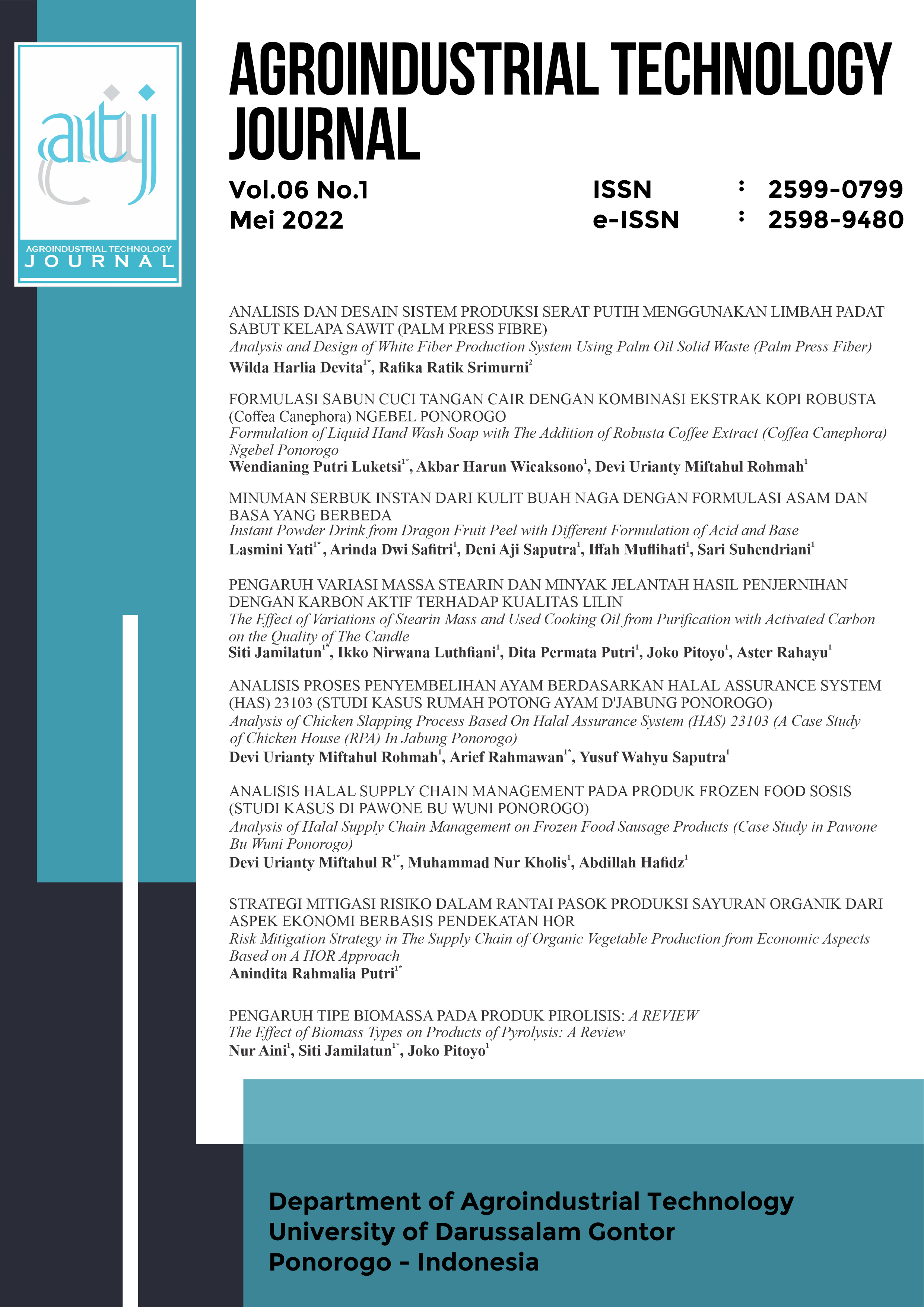
PENGARUH TIPE BIOMASSA PADA PRODUK PIROLISSI: A REVIEW
Effect of Biomass Types on Products of Pyrolysis: A Review
Keywords:
biomass, bio-oil, lignocellulose, pyrolysisAbstract
The exploitation of fossil energy causes non-renewable reserves to dwindle and causes global warming; climate change endangers living things. Energy sources from the second generation, namely lignocellulosic-based biomass, provide development opportunities, not interfere with food reserves, and are easy to cultivate. One technology that is feasible to use to treat lignocellulosic biomass is pyrolysis. Pyrolysis can convert lignocellulosic biomass (including lignin, cellulose, and hemicellulose) into solid, liquid, and gaseous. The pyrolysis mechanism by thermal decomposition goes through several stages, namely charcoal formation, depolymerization, fragmentation, and other secondary reactions. This paper provides insight into the pyrolysis of lignocellulose and its by product. Several parameters, equivalent to reaction environment, temperature, residence time, and heating rate, considerably have an effect on the pyrolysis process. The results of the pyrolysis of various biomass with certain operating conditions obtained yields/products in the form of Bio-oil, Gas and Bio-char with different percentages depending on the treatment.
References
A. Marcilla, JCL Catalä, Garcia-Quesada, FJ. Valdés, dan MR Hernändez, (2013) "Tinjauan tentang konversi mokimia mikroalga",Perbarui Sust Energi Rev, vol. 27, him. (11-19).
S. Mohapatra dan K. Gadgil, (2013). "Biomas: Sumber Utama Bio Energi",Int.J. Perbarui. Res energi,jilid 3(1), him. (20-23).
JP Maity,J. Bundschuh, CY. Chen, dan P. Bhattacharya, (2014). "Mikroalga untuk produksi biofuel generasi ketiga, mitigasi emisi gas rumah kaca dan pengolahan air limbah: Perspektif sekarang dan masa depan, Sedikit ulasan",Energi,hal 1-10.
Administrasi Informasi Energi (ELA), (2016). Energi Internasional Pandangan. http://www.eia.doe.gov/oiaf/ieo/index.htm/diakses Tanggal:21 Juli 2016).
F.Wieland, H. Gueldner dan OR Hild, "Energi terbarukan dan penerangan - secara logis atau artifisial, (2012). "Konferensi Internasional tentang Penelitian dan Aplikasi Energi Terbarukan (ICRERA), Nagasaki”, 201 2, him. (1-5); doi•.1 0.1109/1CRERA.2012.6477351
Sunarno, Rochmadi, P. Mulyono, dan A. Budiman, (2016). "Catalytic cracking of the top phase fraction of bi-oil into upgrade liquid product", AIP Conference Proceedings, 1737 .060008
Edwards, J., (2008), “Pyrolysis of biomass to produce bio-oil, biochar and combustible gas”, Palmerston North: Energy Postgraduate Conference School of Engineering and Advanced Technology Massey University.
Dragone, G., Fernandes, B., Vicente, A., and Teixeira, J.A., (2010), “Third generation biofuels from microalgae”, In: Vilas AM, editor. Current research, technology and education topics in Appl. Microbiol. Biot.,
Badajoz: Formatex Research Center;. pp.(1355-1366).
Maity, J.P., Bundschuh, J., Chen, C-Y., Bhattacharya, P., (2014), “Microalgae for third generation biofuel production, mitigation of greenhouse gas emissions and wastewater treatment: Present and future perspectives: A mini review”. Energy, Volume 78, pp. (104-113).
Suganya, T, Varman,. M., Masjuki, H.H., and Renganathan, S., (2016), “Macroalgae and microalgae as a potential source for commercial applications along with biofuels production: A biorefinery approach”, Renew. Sust. Energ. Rev., 55, 909–941, 2016.
Dickerson, T. and Soria, J., (2013), “Catalytic fast pyrolysis: A Review”, Energy, 6, (514-538).
Basu, P., (2010), “Biomassa gasification and pyrolysis practical design and theory”, Elsevier, The Boulevard, Langford Lane Kidlington, Oxford, UK, pp. (77-82).
Kan, T., Strezov, V., and Evans, T.J., 2016, Lignocellulosic biomass pyrolysis: A review of product properties and effects of pyrolysis parameters, Renewable and Sustainable, Energy Reviews, 57, (1126–1140).
De Wild, P.J., Reith, H., and Heeres, H.J., (2011), “Biomass pyrolysis for chemicals”, Biofuels, 2 (2), 185 – 208.
Campanella, A. and Harold, (2012), Fast pyrolysis of microalgae in a falling solids reactor: Effects of process variables and zeolite catalysts, Biomass. Bioenerg., 46, 218-232.
Zhenga, Y., Taob, L., Yanga, X., Huanga, Y., Liua, C., and Zhenga, Z., (2018). Study of the thermal behavior, kinetics, and product characterization of biomass and low-density polyethylene co-pyrolysis by thermogravimetric analysis and pyrolysis-GC/MS, J. Anal. Appl. Pyrol., 133, (185–197).
Dermibas, A. and Arin, G., (2002) “An overview of biomass pyrolysis”, Energ. Sources, 24, (471-482).
ae, Y. J., Ryu, C., Jeon, J.K., Park, J., Suh, D. J., Suh, Y.W., and Park, Y.K., (2011). “The characteristics of bio-oil produced from the pyrolysis of three marine macroalgae”, Bioresource Technol., 102(3), (3512–20).
Sharma, A., Pareek, V., and Zhang, D., (2015). Biomass pyrolysis—A review of modelling, process parameters and catalytic studies, Renewable and Sustainable Energy Reviews, 50, (1081–1096).
Hoang A T , Hwai Chyuan Ong , I. M. Rizwanul Fattah , Chong C T , Chin Kui Cheng, R. Sakthivel, Yong Sik Ok. (2021). Progress on the lignocellulosic biomass pyrolysis for biofuel production toward environmental sustainability. (1-27).
Uzoejinwa B B, He Xiuhua, Wang Shuang, Abomohra A E, Hu Yamin, Wang Qian. (2018). Co-pyrolysis of biomass and waste plastics as a thermochemical conversion technology for high-grade biofuel production: Recent progress and future directions elsewhere worldwide. Energy Conversion and Management 163 .(468-492). https://doi.org/10.1016/j.enconman.2018.02.004
Fernandez-Akarregi, A.R., Makibar, J., Lopez, G., Amutio, M., Olazar, M., (2013). Design and operation of a conical spouted bed reactor pilot plant (25kg/h) for biomass fast pyrolysis. Fuel Process. Technol. 112, (48–56). https://doi.org/10.1016/j. fuproc.2013.02.022.
Gao, X., Li, T., Rogers, W.A., Smith, K., Gaston, K., Wiggins, G., Parks, J.E., (2020). Validation and application of a multiphase CFD model for hydrodynamics, temperature field and RTD simulation in a pilot-scale biomass pyrolysis vapor phase upgrading reactor. Chem. Eng. J. 388, 124279. https://doi.org/10.1016/j. cej.2020.124279.
Karmee, S.K., Kumari, G., Soni, B., (2020). Pilot scale oxidative fast pyrolysis of sawdust in a fluidized bed reactor: a biorefinery approach. Bioresour. Technol. 318, 124071. https://doi.org/10.1016/j.biortech.2020.124071.
Park, J.Y., Kim, J.-K., Oh, C.-H., Park, J.-W., Kwon, E.E., (2019). Production of bio-oil from fast pyrolysis of biomass using a pilot-scale circulating fluidized bed reactor and its characterization. J. Environ. Manag. 234, (138–144). https://doi.org/10.1016/j.jenvman.2018.12.104.
Soni, B., Karmee, S.K., (2020). Towards a continuous pilot scale pyrolysis based biorefinery for production of biooil and biochar from sawdust. Fuel 271, 117570. https://doi.org/10.1016/j.fuel.2020.117570.
Patwardhan, P.R., Brown, R.C., Shanks, B.H., (2011). Product distribution from the fast pyrolysis of hemicellulose. ChemSusChem 4, (636–643). https://doi.org/10.1002/ cssc.201000425.
Peng, Y., Wu, S., (2010). The structural and thermal characteristics of wheat straw hemicellulose. J. Anal. Appl. Pyrolysis 88, (134–139).https://doi.org/10.1016/j.jaap.2010.03.006.
Peng, Y., Wu, S., (2011). Fast pyrolysis characteristics of sugarcane bagasse hemicellulose. Cellul. Chem. Technol. 45, (605–612). https://www.cellulosechemtchnol. ro/pdf/CCT45,9-10(2011)/p.605-612.
Neupane, S., Adhikari, S., Wang, Z., Ragauskas, A.J., Pu, Y., (2015). Effect of torrefaction on biomass structure and hydrocarbon production from fast pyrolysis. Green Chem.17, (2406–2417). https://doi.org/10.1039/C4GC02383H.
Zhang, J., Choi, Y.S., Yoo, C.G., Kim, T.H., Brown, R.C., Shanks, B.H., (2015). Cellulose–hemicellulose and cellulose–lignin interactions during fast pyrolysis. ACS
Downloads
Submitted
Published
How to Cite
Issue
Section
License
Copyright (c) 2026 Agroindustrial Technology Journal

This work is licensed under a Creative Commons Attribution-NonCommercial-ShareAlike 4.0 International License.
The author whose published manuscript approved the following provisions:
1. The right of publication of all material published in the journal / published in the Agroindustrial Technology Journal is held by the editorial board with the knowledge of the author (moral rights remain the author of the script).
2. The formal legal provisions for access to digital articles of this electronic journal are subject to the terms of the Creative Commons Attribution-NonCommercial-ShareAlike 4.0 International License (CC BY-NC-SA 4.0), which means that Agroindustrial Technology Journal reserves the right to save, transmit media or format, Database), maintain, and publish articles without requesting permission from the Author as long as it keeps the Author's name as the owner of Copyright.
3. Printed and electronically published manuscripts are open access for educational, research and library purposes. In addition to these objectives, the editorial board shall not be liable for violations of copyright law.