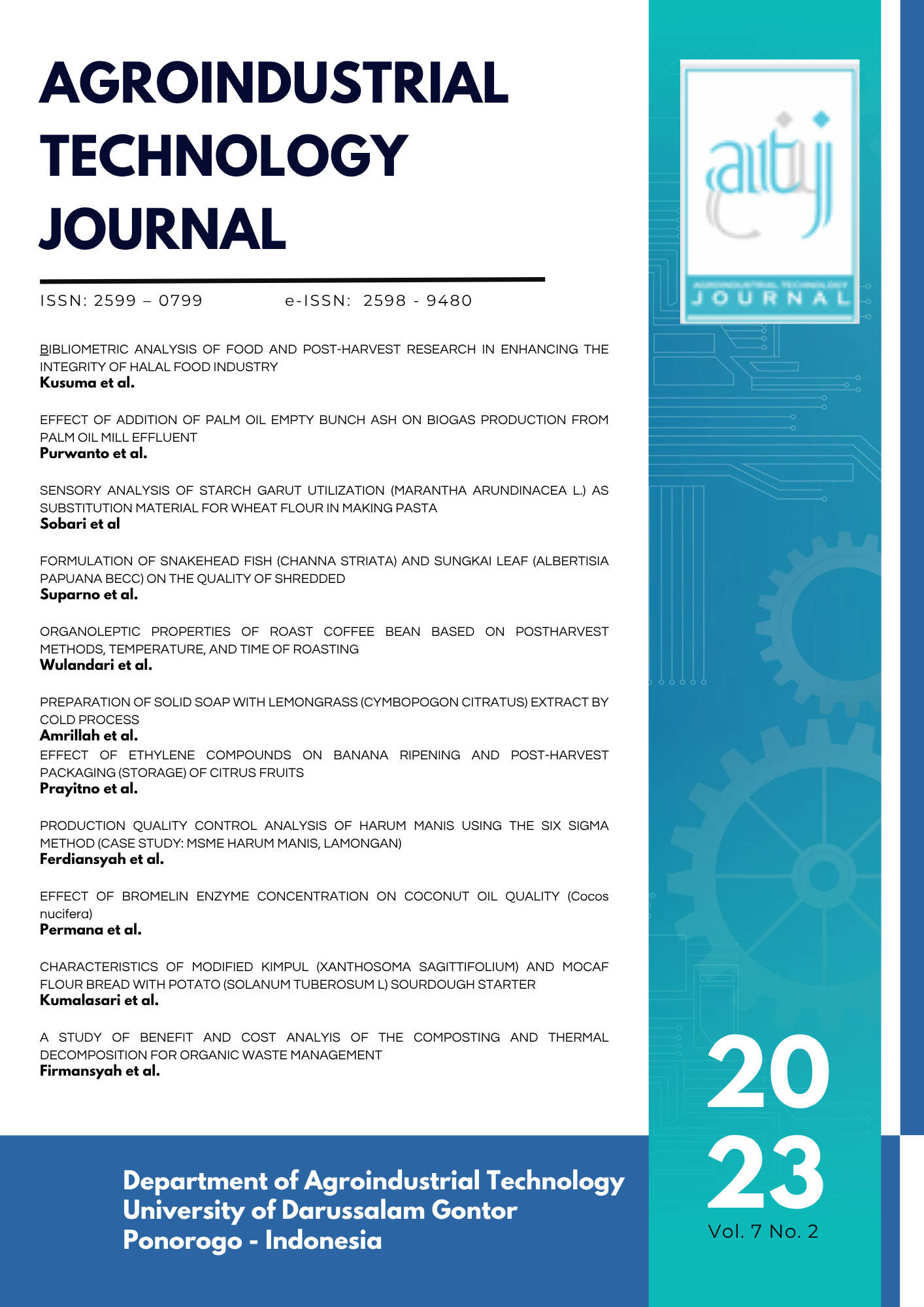
Organoleptic Properties of Roast Coffee Bean Based on Postharvest Methods, Temperature, and Time of Roasting
Keywords:
Coffee, roasting, postharvest methods, organoleptic testsAbstract
Postharvest methodsand roasting processes cause changes in the biochemical composition, physical structure, and organoleptic attributes of coffee. The purpose of this study was to conduct organoleptic tests on roasted red-picked premium Robusta coffee, based on postharvest methods, roasting temperature, and roasting time to obtain the most preferred roasted coffee beans by the panelists. The research design used the Taguchi design with three factors and three levels, Postharvest methodsfactors (full wash, honey, and natural), roasting temperature (150°C, 175°C, and 200°C), and roasting time (10 minutes, 12.5 minutes and 15 minutes) so that the orthogonal array matrix L9 (33) is obtained. The hedonic test (favorability level) in the organoleptic test form consists of a scale of 1-5 rating on each assessed attribute. The panelists consisted of 64 people who were chosen randomly. Data analysis was performed using one-way ANOVA using IBM SPSS Statistics 22. The difference between the means of each treatment was continued with the DMRT test. Postharvest methods, temperature, and roasting time affected the organoleptic of roasted coffee beans, P value or small sig of 0.05 (p<0.05).The most preferred roasted coffee beans by panelist were honey posthervest method, roasting temperature of175°C, and roasting time of 15 minutes.
References
Agustina, R., Nurba, D., Antono, W., Septiana, R., Studi, P., Pertanian, T., & Pertanian, F. (2019). Pengaruh Suhu Dan Lama Penyangraian Terhadap Sifat Fisik-Kimia Kopi Arabika Dan Kopi Robusta. In ProsidingSeminar Nasional.Anwar, M., Staf Pengajar Pada Program, M., Teknologi, S., Pertanian, H., & Pertanian, F. (2017). Studi Kualitas Organoleptik Bubuk Biji Kopi Dengan Aplikasi Good Manufacturing Process Dan Hazard Analysis Critical Control Point Di Kota Ternate. Jurnal Ilmiah agribisnis dan Perikanan (agrikan UMMU-Ternate). Volume 10 Nomor 2Akillioglu, H. G., &Gökmen, V. (2014).Mitigation of acrylamide and hydroxymethyl furfural in instant coffee by yeast fermentation.. Journal of Food Engineering, 112(3), 243–252. https://doi.org/10.1016/j.jfoodeng.2012.04.009Civille, G. V., & Oftedal, K. N. (2012). Sensory evaluation techniques -Make “good for you” taste “good.” Physiology and Behavior,107(4), 598–605. https://doi.org/10.1016/j.physbeh.2012.04.015Edvan, B. T., Rachmad E., dan Made S. 2016. Pengaruh Jenis dan Lama Penyangraian pada Mutu Kopi Robusta (Coffea robusta). Jurnal AIP. 4(1): 31-40.Fernanda, A. S., Widanti, Y. A., dan Kurniawati, L. (2017). Karakteristik Stik Vegetarian dengan Substitusi Tepung Pisang Tanduk (Musa Paradisiaca Formatypica). Dan Tempe Sebagai Sumber Protein. Jurnal Teknologi dan Industri Pangan. 2(2) : 74-80.Haile M and Kang W H (2019) The Role of Microbes in Coffee Fermentation and Their Impact on Coffee Quality. J of Food Quality. 6 Hečimović, I., A.B. Cvitanović, D. Horžić, and D. Komes. 2011. Comparative study of poliphenols and caffeine in different coffee varieties affected by degree of roasting. Food Chemistry. 129: 991–1000.Henrique, C., Reinato, R., Meira Borem, F., Cirillo, M. Â., & Oliveira, E. C.
(2012). Qualidade Do Café Secado Em Terreiros Com Diferentes Pavimentações E Espessuras De Camada Quality Of The Coffee Dryed On Grounds With Different Surfaces And Thickness Layers.Coffee Science,7(3)(2012), pp.223-237Kleinwächter M, Bytof G, and Selmar D 2015 Coffee Beans and Processing. In Coffee in Health and Disease Prevention( Elsevier Inc) Chapter 9 73Mafaza, A, Fikri, K., Prihandono, T., & Nuraini, L. (2021). Pengaruh Suhu Dan Lama Waktu Penyangraian Terhadap Massa Jenis Biji Kopi Robusta Menggunakan Mesin Roasting Tipe Hot Air. Jurnal Pembelajaran Fisika. Vol. 10 No. 1 hal 29-35Mubarak Suud, H., Ayu Savitri, D., & Rajni Ismaya, S. (2021). Perubahan Sifat Fisik Dan Cita Rasa Kopi Arabika Asal Bondowoso Pada Berbagai Tingkat Penyangraian .Jurnal AGROTEK. (Vol. 8, Issue 2).Mulato, S. (2018). Penyangraian Biji Kopi. Coffee dan Cacao Training Center.Musyofa, F., Fuad, M. F., Raya Telang BOX, J. P., & Bangkalan Jawa Timur, K. (2022). Aktivitas Antioksidan, Sifat Fisik Dan Sifat Sensoris Stik Buah Naga Merah(Hylocereus polyrhizus). Agroindustrial Technology Journal, 6(2), 1–17. https://doi.org/10.21111/atj.v6i2.7707Pereira, L. L., Guarçoni, R. C., Pinheiro, P. F., Osório, V. M., Pinheiro, C. A., Moreira, T. R., & ten Caten, C. S. (2020). New propositions about coffee wet processing: Chemical and sensory perspectives.Food Chemistry, 310. https://doi.org/10.1016/j.foodchem.2019.125943.Pittia, P., Dalla Rosa, M., & Lerici, C. R. (2001). Textural Changes of Coffee Beans as Affected by Roasting Conditions. LWT, 34(3), 168–175. https://doi.org/10.1006/fstl.2000.0749Purnamayanti, N. P. A., I.B. P. Gunadnya, dan G. Arda. 2017. Pengaruh Suhu dan Lama Penyangraian terhadap Karakteristik Fisik dan Mutu Sensori Kopi Arabika (Coffea arabica L). Jurnal Beta (Biosistem Dan Teknik Pertanian). 5(2).Susanti, R., Ressy, Z., Fedri, A. &, & Satrio, T. (2017). Monitoring Suhu Proses Sangrai Biji Kopi Temperature Monitoring For Coffe Seed Rosting. POLI REKAYASA, 12(2). DOI:http://dx.doi.org/10.30630/jipr.12.2.50Sutarsi, Rhosida, E., Iwan, T. (2016). Penentuan Tingkat Sangrai Kopi Berdasarkan Sifat Fisik Kimia Menggunakan Mesin Penyangrai Tipe Rotari. Prosiding Seminar Nasional Apta, Jember 26-27 Oktober 2016Wulandari, S., Ainuri, M., & Sukartiko, A. C. (2022a). Sensory Evaluation of Robusta Coffee under Various Postharvest and Processing. Proceedings of the 2nd International Conference on Smart and Innovative Agriculture (ICoSIA 2021)Wulandari, S., Ainuri, M., & Sukartiko, A. (2022b). Biochemical Characteristics of Ground Robusta Coffee under Various Postharvest Technologies and Processing Parameters. 333–343. https://doi.org/10.5220/0010753900003113
Downloads
Submitted
Published
How to Cite
Issue
Section
License
Copyright (c) 2023 Agroindustrial Technology Journal

This work is licensed under a Creative Commons Attribution-NonCommercial-ShareAlike 4.0 International License.
The author whose published manuscript approved the following provisions:
1. The right of publication of all material published in the journal / published in the Agroindustrial Technology Journal is held by the editorial board with the knowledge of the author (moral rights remain the author of the script).
2. The formal legal provisions for access to digital articles of this electronic journal are subject to the terms of the Creative Commons Attribution-NonCommercial-ShareAlike 4.0 International License (CC BY-NC-SA 4.0), which means that Agroindustrial Technology Journal reserves the right to save, transmit media or format, Database), maintain, and publish articles without requesting permission from the Author as long as it keeps the Author's name as the owner of Copyright.
3. Printed and electronically published manuscripts are open access for educational, research and library purposes. In addition to these objectives, the editorial board shall not be liable for violations of copyright law.