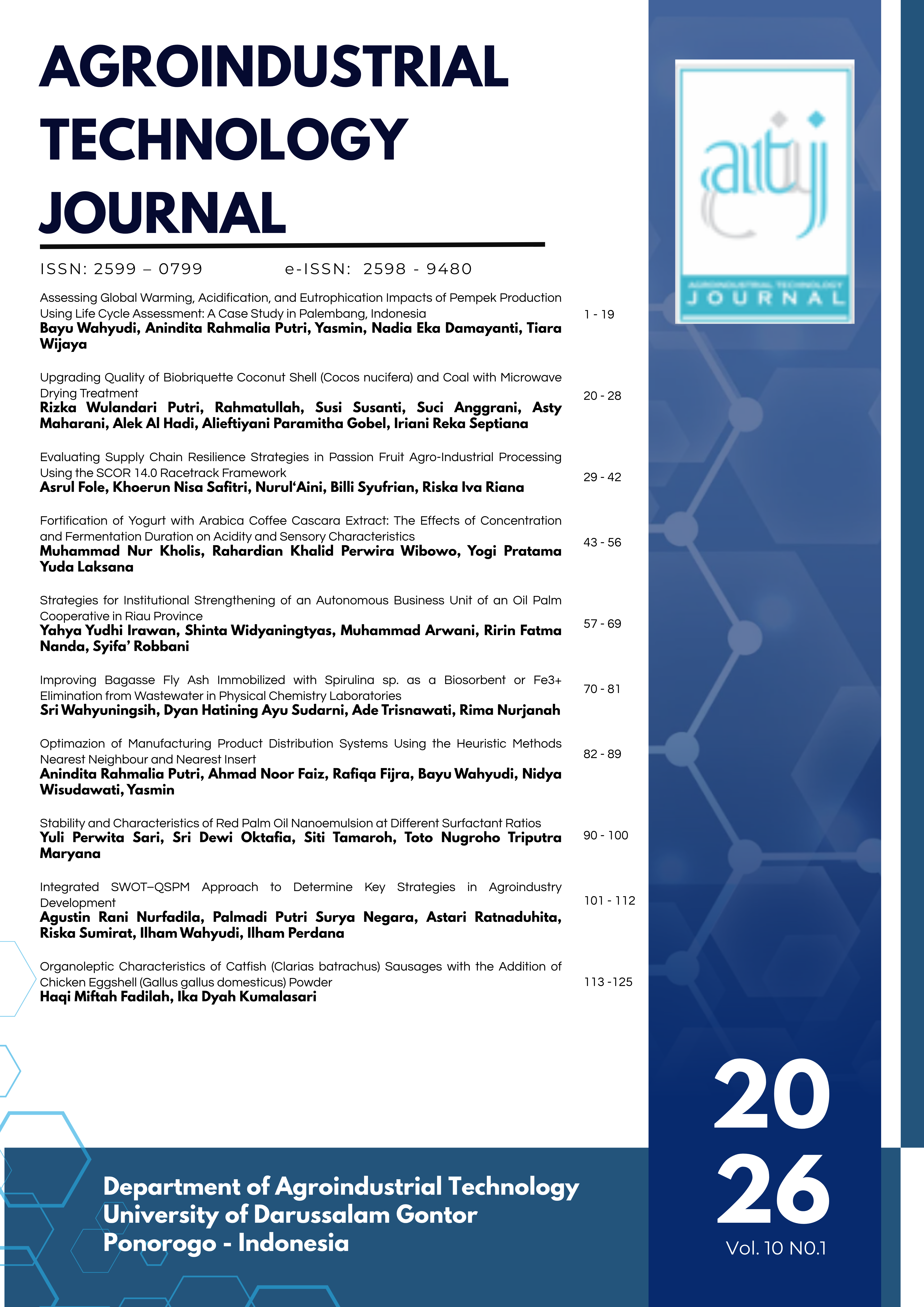
Upgrading Quality of Biobriquette Coconut Shell (Cocos nucifera) and Coal with Microwave Drying Treatment
DOI:
https://doi.org/10.21111/atj.v10i1.10Keywords:
Briquettes, Coconut Shell, Sub-bituminous Coal, Carbonization, Microwave, Proximate AnalysisAbstract
Subbituminous coal is found abundantly in Indonesia, especially in Sumatra, has significant potential for use as a raw material for briquettes and bio-briquettes. Subbituminous coal is a type of medium-rank coal with low calorific value about 4500-5000 cal/g. Therefore, the combination of coal with coconut shell biomass can increase the calorific value and briquettes quality. This study aims to improve the quality of biobriquettes through variations in carbonization temperature, the ratio of coconut shells to sub-bituminous coal, and the microwave drying. The briquette production conducted with carbonization process in 2 hours with variation temperature used were 300°C and 400°C, and raw material ratios consisted of 0:100, 25:75, 50:50, and 75:25 with the addition of tapioca adhesive of 15%. Low temperature carbonization (300-400°C) improves fuel quality by removing moisture and volatile matter, resulting in bio-briquettes with high calorific values. The optimal raw material ratio helps reduce combustion exhaust emissions. The charcoal crushed, mixed, casted and dried with microwave drying at 800 Watt. Microwave treatment contributed significantly to the reduction of moisture and ash content. The product briquettes were analyzed based on proximate parameters. The best conditions were achieved at a 75% coconut shell: 25% coal and a carbonization temperature of 300°C, characterized by the highest calorific value (5655 cal/g), the lowest ash content (0.65%), and the lowest inherent moisture (7.74%) that meets briquette quality standards of PERMEN ESDM No. 47/2006, while the lowest volatile matter (42.93%) and the highest carbon (48.77%) was also achieved in 75% coconut shell: 25% coal.
References
Aini, N. A., Jamilatun, S., & Pitoyo, J. (2022). PIROLISIS BIOMASSA: REVIEW. Agroindustrial Technology Journal, 6(1), 89–101. https://doi.org/10.21111/atj.v6i1.7559
Ardiansyah, I., Putra, A. Y., & Sari, Y. (2022). Analisis Nilai Kalor Berbagai Jenis Briket Biomassa Secara Kalorimeter. Journal of Research and Education Chemistry, 4(2), 120-133. https://doi.org/10.25299/jrec.2022.vol4(2).10735
(BPS) Badan Pusat Statistik Provinsi Sumatera Selatan. Produksi tanaman perkebunan (Diakses tanggal 25 April 2025). .https://sumsel.bps.go.id/id/statisticstable/2/NDE2IzI%3D/produksi-tanaman-perkebunan.html
Hanifah, A., Sumirat, R., Soerya, S. F., & Aristri, M. A. (2025). Isolation and Characterization of Cellulose from Biomass: A Methodological Review: Isolation and Characterization of Cellulose from Biomass: A Methodological Review. Agroindustrial Technology Journal, 9(1), 15–33. https://doi.org/10.21111/atj.v9i1.14568
Inegbedion, F. (2022). Estimation of the Moisture Content, Ash Matter, Ash Content, Fixed Carbon and Calorific Values of Saw Dust Briquettes. MANAS Journal of Engineering, 10(1), 17-20. https://doi.org/10.51354/mjen.940760
Jiang, C., Bo, J., Xiao, X., Zhang, S., Wang, Z., Yan, G., Wu, Y., Wong, C., & He, H. (2020). Converting Waste Lignin Into Nano-Biochar as A Renewable Substitute of Carbon Black for Reinforcing Styrene-Butadiene Rubber. Waste Management, 102, 732–742. https://doi.org/10.1016/j.wasman.2019.11.019
Kusman, M. R., Faruk, F., & Sibua, S. (2024). Penggunaan Eceng Gondok (Eichhorina Crassipes) Sebagai Bahan Bakar Alternatif Biobriket di Danau Galela. Jurnal Serambi Engineering, 9(4), 11320-11325.
Li Y, Xing B, Ding Y, Han, X., & Wang, S. (2020.) A Critical Review of The Production and Advanced Utilization of Biochar Via Selective Pyrolysis, 312. https://doi.org/10.1016/j.biortech.2020.123614
Liu, A., Liu, S., Liu, P., & Wang, K. (2021) Water Sorption on Coal: Effects of Oxygen-Containing Function Groups and Pore Structure. International Journal of Coal Science & Technology, 8(5), 983-1002. https://doi.org/10.1007/s40789-021-00424-6
Murni, S. W., Setyoningrum, T. M., & Nur, M. M. A. (2021). Production of Briquettes from Indonesia Agricultural Biomass Waste by Using Pyrolysis Process and Comparing The Characteristics. Eksergi, 18(1), 13-17. https://doi.org/10.31315/e.v0i0.4572
Nurhayati, C. (2018). Pengaruh Temperatur Karbonisasi, Komposisi Campuran Arang Kayu Karet dan Lumpur Batubara Terhadap Kualitas Biobriket. Indonesian Journal of Industrial Research, 1(1), 48-56.
Putri, R. W., Rahmatullah, S., Santoso, B., Savitri, A., & Zahara, M. (2024). Effect of Drying Temperature of Sawdust Biobriquettes with Used Lubricant Oil Adhesive Volume Variation over Carbonization Process. Journal of Ecological Engineering, 25(2), 309-320. https://doi.org/10.12911/22998993/174964
Role, N. V. N., Murdiyanto, D., & Mbulu, B. C. P. (2024). The Effect Of Coating Temperature And Particle Size On The Burning Time Of Kempi Shell Briquettes. Jurnal Metal, 2(1), 27-33. https://doi.org/10.59581/metal.v2i1.96
Santosa, K. M., Firmanto, H., Mufandi, I., & Anggraeni, N. (2023). The Potential of Coffee and Cocoa Shell Waste as An Energy Source: Analysis of Characteristics of Briquettes From Coffee and Cocoa Shell Waste Through The Carbonization Process. Agroindustrial Technology Journal, 7(3), 88–103. https://doi.org/10.21111/atj.v7i3.11245
Sumiati., Sari, N. M., & Lusyiani. (2023). Pengaruh Komposisi Briket Campuran Arang Dari Limbah Batubara Dan Serbuk Arang Kayu Ulin (Eusideroxylon Zwageri) Terhadap Kualitas Dan Laju Pembakaran. Jurnal Sylva Scienteae, 6(5), 830-839. https://doi.org/10.20527/jss.v6i5.10663
Syarif, A., Yerizam, M., Indrayani, I., & Yopinita, A. (2023). Effect of Composition of Coconut Shell Charcoal and Char Gasification on the Quality of Biobriquettes. In 6th FIRST 2022 International Conference (FIRST-ESCSI-22). Politeknik Negeri Sriwijaya. Palembang, 7–8 September 2022.
Xu, Y., Chen, X., Zhao, W., & Chen, P. (2022). Experimental and Numerical Simulation of Water Adsorption and Diffusion In Coals With Inorganic Minerals. Energies, 15(12), 1-15. https://doi.org/10.3390/en15124321
Wang, Y., Duan, Y., Liang, X., Tang, L., Sun, L., Wang, R., Wei, S., Huang, H., Yang, P., & Hu, H. (2023). Hierarchical Porous Activated Carbon Derived from Coconut Shell For Ultrahigh-Performance Supercapacitors. Molecules, 28(20), 1-14. https://doi.org/10.3390/molecules28207187
Downloads
Submitted
Accepted
Published
How to Cite
Issue
Section
License
Copyright (c) 2026 Agroindustrial Technology Journal

This work is licensed under a Creative Commons Attribution-NonCommercial-ShareAlike 4.0 International License.
The author whose published manuscript approved the following provisions:
1. The right of publication of all material published in the journal / published in the Agroindustrial Technology Journal is held by the editorial board with the knowledge of the author (moral rights remain the author of the script).
2. The formal legal provisions for access to digital articles of this electronic journal are subject to the terms of the Creative Commons Attribution-NonCommercial-ShareAlike 4.0 International License (CC BY-NC-SA 4.0), which means that Agroindustrial Technology Journal reserves the right to save, transmit media or format, Database), maintain, and publish articles without requesting permission from the Author as long as it keeps the Author's name as the owner of Copyright.
3. Printed and electronically published manuscripts are open access for educational, research and library purposes. In addition to these objectives, the editorial board shall not be liable for violations of copyright law.