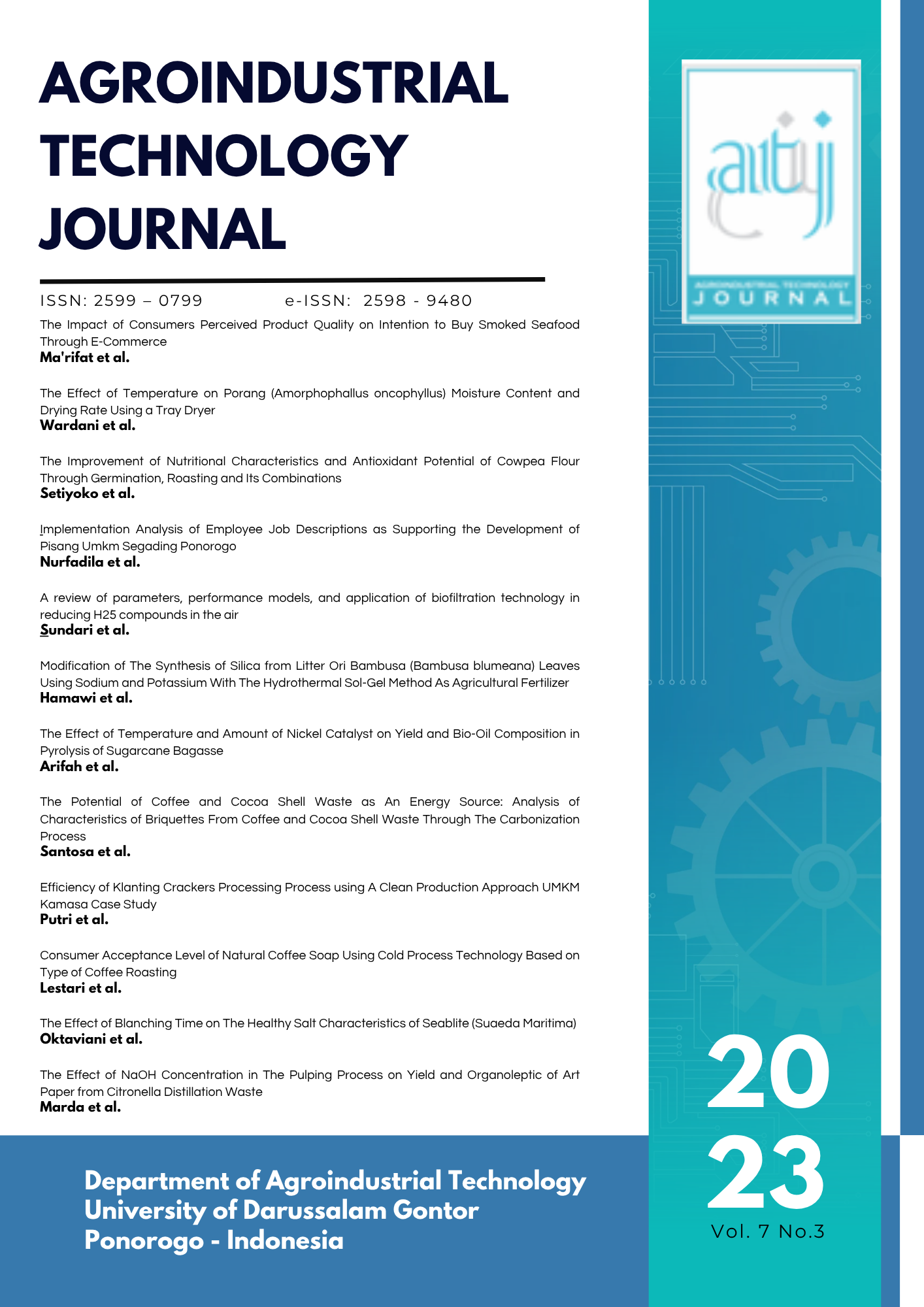
THE IMPACT OF CONSUMERS PERCEIVED PRODUCT QUALITY TO INTENTION TO BUY SMOKED SEAFOOD THROUGH E-COMMERCE
Keywords:
Consumer Behavior, Fisheries Product, Linear Regression, Online MarketingAbstract
The increasingly massive use of e-commerce in Indonesia has encouraged producers of seafood products to market their products through e-commerce. One of the most popular seafood products in Indonesia is smoked seafood. Smoked seafood with unique product quality characteristics and simple production technology have wider marketing potential if marketed through e-commerce. Therefore, to develop smoked seafood products through e-commerce, this study aims to determine the relationship between perceived quality of smoked seafood products and consumer purchase intentions through e-commerce. The data collection method used was through online questionnaire with multiple linear regression analysis. The analysis resulted in the findings that the factor having most influences to the intensity of consumers in buying smoked seafood products through e-commerce is user display. The implication of the results is that attractive user interface on an e-commerce platform can enhance consumers' interest and purchase intensity. Smoked seafood producers who will market their product through e-commerce need to pay attention to the design of product displays and provide a positive user experience to boost sales of their products.
References
Arthatiani, F. Y., Kusnadi, N., & Harianto, H. (2018). Analisis Pola Konsumsi Dan Model Permintaan Ikan Menurut Karakteristik Rumah Tangga Di Indonesia. Jurnal Sosial Ekonomi Kelautan Dan Perikanan, 13(1), 73. https://doi.org/10.15578/jsekp.v13i1.6967Birch, D., Memery, J., Johns, N., & Musarskaya, M. (2018). Stimulating UK adolescents’ seafood consumption. Journal of International Food & Agribusiness Marketing, 30(1), 61–69.Chen, L., Rashidin, M. S., Song, F., Wang, Y., Javed, S., & Wang, J. (2021). Determinants of Consumer’s Purchase Intention on Fresh E-Commerce Platform: Perspective of UTAUT Model. SAGE Open, 11(2), 21582440211027876. https://doi.org/10.1177/21582440211027875DBS Bank. (2020). Indonesia’s e-commerce ranks first in Southeast Asia. https://www.dbs.com/newsroom/Indonesias_ecommerce_ranks_first_in_Southeast_AsiaGlen, S. (n.d.). Cronbach’s Alpha Definition, Interpretation, SPSS. Retrieved August 1, 2022, from https://www.statisticshowto.com/probability-and-statistics/statistics-definitions/cronbachs-alpha-spss/Hair, J., Anderson, R., Black, B., & Babin, B. (2016). Multivariate Data Analysis. Pearson Education. https://books.google.co.id/books?id=LKOSAgAAQBAJJaffe, T. R., Wang, H., & Chambers, E. (2017). Determination of a lexicon for the sensory flavor attributes of smoked food products. Journal of Sensory Studies, 32(3). https://doi.org/10.1111/joss.12262Jalilvand, M. R., Samiei, N., & Mahdavinia, S. H. (2011). The effect of brand equity components on purchase intention: An application of Aaker’s model in the automobile industry. International Business and Management, 2(2), 149–158.Lu, H. (2020). Marketing network of marine products under e-commerce mode. Journal of Coastal Research, 106(SI), 267–271.Mirabi, V., Akbariyeh, H., & Tahmasebifard, H. (2015). A study of factors affecting on customers purchase intention. Journal of Multidisciplinary Engineering Science and Technology (JMEST), 2(1).Nugraha, M. R., Sumarwan, U., & Yulianti, L. N. (2019). Social Shopping Relationship Management on Social E-Commerce in Indonesia (Case Study: Online Food Consumers). ASEAN Marketing Journal, 10(1), 52–65. https://doi.org/10.21002/amj.v10i1.10629Olsen, S. O., Tuu, H. H., & Grunert, K. G. (2017). Attribute importance segmentation of Norwegian seafood consumers: The inclusion of salient packaging attributes. Appetite, 117, 214–223. https://doi.org/https://doi.org/10.1016/j.appet.2017.06.028Taka, T. (2022). Content Analysis of Seafood E-commerce Sites Using a Text Mining Approach: A Case Study of Japan. Journal of International Food & Agribusiness Marketing, 1–12. https://doi.org/10.1080/08974438.2022.2104416Tomić, M., Matulić, D., & Jelić, M. (2016). What determines fresh fish consumption in Croatia? Appetite, 106, 13–22. https://doi.org/https://doi.org/10.1016/j.appet.2015.12.019Utami, R., & Djaafar, T. F. (2015). Keberagaman umbi-umbian sebagai pangan fungsional. Prosiding Seminar Hasil Penelitian Tanaman Aneka Kacang Dan Umbi 2014, 22, 950–960.Verbeke, W., & Vackier, I. (2005). Individual determinants of fish consumption: application of the theory of planned behaviour. Appetite, 44(1), 67–82. https://doi.org/https://doi.org/10.1016/j.appet.2004.08.006Wang, O., & Somogyi, S. (2018). Consumer adoption of online food shopping in China. British Food Journal.Wicaksana, I., Nurmalina, R., & Suprehatin, S. (2020). Value Chain Governance for Smoked Fish Products in the North Coast of Central Java. Jurnal Manajemen Dan Agribisnis, 17(3), 304–314. https://doi.org/10.17358/jma.17.3.304Wihardja, M. M., & Ali, R. (2021). Insights from The Covid-19 Digital Merchant Survey. https://thedocs.worldbank.org/en/doc/e975e535c0a25907216079e138c56307-0070012021/original/Indonesia-Shopee-World-Bank-Digital-Merchant-Survey.pdfYee, C. C., Tran, N., Dao, C. D., Sulser, T. B., Phillips, M. J., Batka, M., Wiebe, K., & Preston, N. (2017). Fish to 2050 in the ASEAN region. Working Paper. WorldFish. International Food Policy Research Institute (IFPRI).
Downloads
Submitted
Published
How to Cite
Issue
Section
License
Copyright (c) 2024 Agroindustrial Technology Journal

This work is licensed under a Creative Commons Attribution-NonCommercial-ShareAlike 4.0 International License.
The author whose published manuscript approved the following provisions:
1. The right of publication of all material published in the journal / published in the Agroindustrial Technology Journal is held by the editorial board with the knowledge of the author (moral rights remain the author of the script).
2. The formal legal provisions for access to digital articles of this electronic journal are subject to the terms of the Creative Commons Attribution-NonCommercial-ShareAlike 4.0 International License (CC BY-NC-SA 4.0), which means that Agroindustrial Technology Journal reserves the right to save, transmit media or format, Database), maintain, and publish articles without requesting permission from the Author as long as it keeps the Author's name as the owner of Copyright.
3. Printed and electronically published manuscripts are open access for educational, research and library purposes. In addition to these objectives, the editorial board shall not be liable for violations of copyright law.