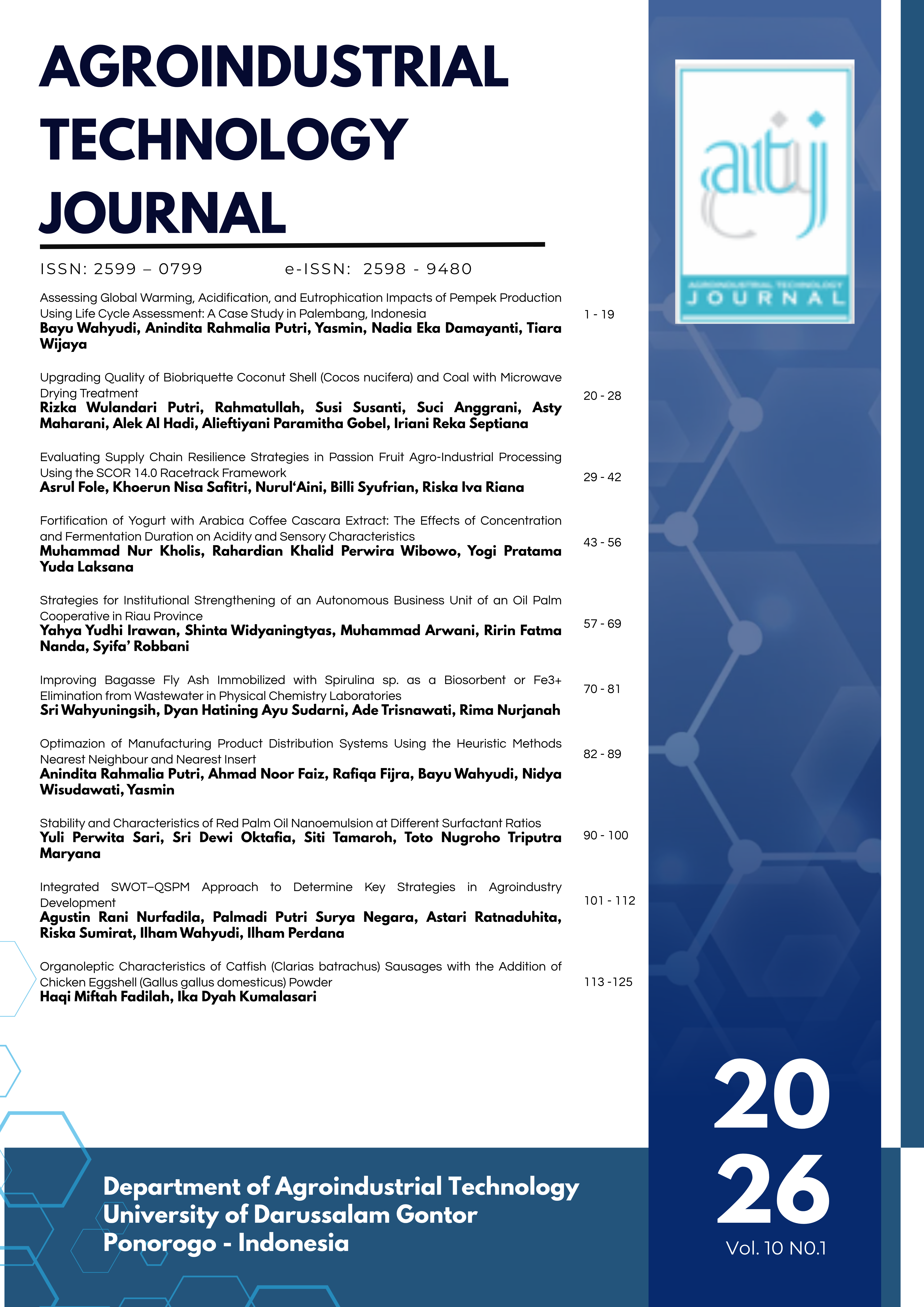
Assessing Global Warming, Acidification, and Eutrophication Impacts of Pempek Production Using Life Cycle Assessment: A Case Study in Palembang, Indonesia
DOI:
https://doi.org/10.21111/atj.v10i1.29Keywords:
acidification, eutrophication, global warming potential, life cycle assessment, pempek productionAbstract
Traditional food production may generate environmental burdens through raw material sourcing, energy consumption, processing activities, packaging, distribution, and waste generation. This study assessed the environmental impacts of pempek production in a small-scale industry in Palembang, Indonesia, using the Life Cycle Assessment (LCA) approach. The assessment was conducted using the CML-IA Baseline method in SimaPro version 9.5.0.0, with a system boundary covering raw material procurement, dough preparation, resting, shaping, frying, packaging, distribution, and waste-related activities. Inventory data were collected based on one production cycle at Pempek X and included material inputs, energy use, water use, fuel consumption, packaging materials, and emission factors. The results showed that pempek production generated 311.96 kg CO₂-eq for Global Warming Potential (GWP), 2.397 kg SO₂-eq for Acidification Potential (AP), and 4.197 kg PO₄³⁻-eq for Eutrophication Potential (EP) per production cycle. The frying stage was the main contributor to GWP (32.1%) and EP (61.3%), mainly due to thermal energy use and cooking oil consumption. The packaging stage contributed the largest share to AP (approximately 27.0%) and also had a substantial contribution to GWP (25.2%). From the raw material perspective, wheat flour was the dominant contributor across several impact categories, followed by palm oil, demersal fish, tofu, and eggs. These impacts were mainly associated with upstream agricultural activities, energy use, and material production processes. The findings indicate that energy-intensive processing, raw material supply chains, and packaging materials are key environmental hotspots in pempek production. Improving frying efficiency, selecting lower-impact packaging, strengthening waste management, and sourcing more sustainable raw materials were recommended to reduce environmental burdens. This study demonstrates the usefulness of LCA for identifying improvement priorities in traditional food production systems.
References
Ar Rachmah, A. N., Fauzi, A. M., & Bustami. (2020). Life Cycle Assessment of Fisheries Commodity in Muncar Banyuwangi, Jawa Timur. Jurnal Standarisasi, 22(3), 245–252.
Badan Standarisasi Nasional. (2016). SNI ISO 14040:2016 Manajemen Lingkungan Penilain Daur Hidup Prinsip dan Kerangka Kerja. www.bsn.go.id
Brock, A., & Williams, I. (2020). Life cycle assessment of beverage packaging. Detritus, 13, 47–61. https://doi.org/10.31025/2611-4135/2020.14025
Chiu, Y. (2019). Environmental Implications of Taiwanese Oolong Tea and the Opportunities of Impact Reduction. Sustainability, 11(6042). https://doi.org/10.3390/su11216042
Curran, M. A. (2012). Life Cycle Assessment Handbook. Scrivener Publishing. https://doi.org/10.1002/9781118528372
Duan, M., O’Dwyer, E., Stuckey, D. C., & Guo, M. (2019). Wastewater To Resource: Design of a Sustainable Phosphorus Recovery System. ChemistryOpen, 8, 1109–1120. https://doi.org/10.1002/open.201900189
Falciano, A., Cimini, A., Masi, P., & Moresi, M. (2022). Carbon Footprint of a Typical Neapolitan Pizzeria. Sustainability, 14(3125). https://doi.org/10.3390/su14053125 Academic
Frisilla, M. C., Pramudyaningrum, R., & Apriani, I. (2024). Analisis Produksi Bersih Industri Skala Kecil (Rumahan) di Kota Pontianak. Jurnal Teknologi Lingkungan Lahan Basah, 12(1), 66–74. https://doi.org/10.26418/jtllb.v12i1.73128
Guinée, J. B., Gorrée, M., Huppes, R. H. G., Kleijn, R., de Koning, A., van Oers, L., & Haes, A. W. S. – S. S. – H. A. U. de. (2002). Handbook on Life Cycle Assessment (7th ed.). Kluwer Academic Publishers.
Hapuwatte, B. M., & Jawahir, I. S. (2021). Closed-loop sustainable product design for circular economy. Journal of Industrial Ecology, 25(6), 1430–1446. https://doi.org/10.1111/jiec.13154
Harjanto, T. R., Khasanah, M., & Putri, A. N. R. (2022). Industri Tahu Rakyat dalam Tinjauan Life Cycle Assessment. Jurnal Pengendalian Pencemaran Lingkungan (JPPL), 4(2), 65–73. https://doi.org/10.35970/jppl.v4i2.1436
Hauschild, M. Z., Rosenbaum, R. K., & Olsen, S. I. (2018). Life Cycle Assessment: Theory and Practice. Springer International Publishing. https://doi.org/10.1007/978-3-319-56475-3_33
Ichsan, A. S., Iswanto, N., Dewayanto, N., & Amrullah, O. R. (2025). Life Cycle Assessment of Heavy Equipment Repair and Hazardous Waste Storage: Environmental Optimization at a Coal Mining Contractor. Agroindustrial Technology Journal, 9(2), 69–90. https://doi.org/10.21111/atj.v9i2.15141
Junianto, Susilo, B., Irsyad, I., H, M. T. P., & Mahesa, L. (2024). Analisis Kelayakan Bisnis UMKM Pengolahan Pempek Berbahan Baku Ikan Tenggiri di Kecamatan Cileunyi Kabupaten Bandung. AGRIDEVINA Berkala Ilmiah Agribisnis, 13(1), 51–57.
Kementerian Lingkungan Hidup dan Kehutanan. (2021). Peraturan Mentri Lingkungan Hidup dan Kehutanan Republik Indonesia No. 1 tahun 2021. In Kementrian LHK RI.
Kementrian ESDM. (2023). Nilai Faktor Emisi (FE). In Kementrian ESDM. https://www.esdm.go.id/
Kheiralipour, K., Brand, M., Holka, M., & Chorynski, A. (2024). A Review of Environmental Impacts of Wheat Production in Different Agrotechnical Systems. Resources, 13(93). https://doi.org/10.3390/ resources13070093
Omar, A., & Muthusamy, K. (2022). Concrete Industry, Environment Issue, and Green Concrete: A Review. Construction, 1(2), 1–9. https://doi.org/10.15282/cons.v2i1.7188
Pianjing, P., & Wites, J. (2021). Life Cycle Analysis of Milkfish Fingerlings Production in Thailand. International Journal of Environmental Science and Development, 12(11), 332–338. https://doi.org/10.18178/ijesd.2021.12.11.1358
Pusat Studi Transportasi dan Logistik UGM. (2017). Inventarisasi dan Penyusunan Profil Gas Rumah Kaca Kota Yogyakarta.
Rahmawati, E. (2022). Analisis Life Cycle Assessment untuk Menentukan Dampak Lingkungan pada Proses Produksi Tahu di Industri Kecil “UD. X” Desa Sidojangkung, Kecamatan Menganti, Gresik. In Universitas Islam Negeri Sunan Ampel (Vol. 33, Issue 1). Universitas Islam Negeri Sunan Ampel.
Rusdiani, R. R. (2018). Kajian faktor emisi kendaraan bermotor bahan bakar gasolin roda dua di kota surabaya. Institut Teknologi Sepuluh Nopember.
Sari, D. A. P., Rahmah, A., & Sasongko, N. A. (2023). Life Cycle Assessment (LCA) in Palm Oil Plantation and Mill with Impact Categories Global Warming Potential, Acidification, and Eutrophication. International Journal of Membrane Science and Technology, 10(2), 797–807.
Setiawan, A., Purwanto, M. Y. J., & Siregar, K. (2021). Life cycle assessment of cement production with alternative fuels usage in Indonesia. Journal of Natural Resources and Environmental Management, 11(3), 474–489. https://doi.org/10.29244/jpsl.11.3.474-489
Sirait, M. (2020). Studi Life Cycle Assessment Produksi Gula Tebu : Studi Kasus di Jawa Timur. Rekayasa, 13(2), 197–204. https://doi.org/10.21107/rekayasa.v13i2.5915
Sonnemann, G., Tsang, M., & Schuhmacher, M. (2019). Integrated Life-Cycle and Risk Assessment for Industrial Processes and Products (2nd ed.). Taylor & Francis. https://doi.org/10.1201/9780429436949
Svanes, E., Waalen, W., & Uhlen, A. K. (2020). Environmental Impacts of Rapeseed and Turnip Rapeseed Grown in Norway, Rape Oil and Press Cake. Sustainability, 12(10407), 1–22.
Syarifuddin, Arfilla, D., & Fadilla. (2022). Eksistensi Kuliner Pempek sebagai Icon Kota Palembang (Studi Sejarah dan Budaya). Rihlah: Jurnal Sejarah Dan Kebudayaan, 10(02), 133–144. https://doi.org/10.24252/rihlah.v10i01.35146
Thamir, A. D., Lafta, S. H., Mohammed, F. Q., & Hanon, M. M. (2019). Environmental Impact Assessment of Halfaya Oilfield Project. Engineering and Technology Journal, 37(2C), 258–267. https://doi.org/10.30684/etj.37.2c.10
Tian, H., Wang, X., Lim, E. Y., Lee, J. T. E., Ee, A. W. L., Zhang, J., & Tong, Y. W. (2021). Life cycle assessment of food waste to energy and resources: Centralized and decentralized anaerobic digestion with different downstream biogas utilization. Renewable and Sustainable Energy Reviews, 150(July), 1–19. https://doi.org/10.1016/j.rser.2021.111489
Tiarani, V. L., Sutrisno, E., & Huboyo, H. S. (2016). Kajian beban Emisi Pencemar Udara (TSP, NOx, SO2, HC, CO) dan Gas Rumah Kaca (CO2, CH4, N2O) Sektor Transportasi Darat Kota Yogyakarta dengan Metode Tier 1 dan Tier 2. Jurnal Teknik Lingkungan, 5(1), 1–10.
van der Werf, H. M. G., Knudsen, M. T., & Cederberg, C. (2020). Towards better representation of organic agriculture in life cycle assessment. Nature Sustainability, 3(6), 419–425. https://doi.org/10.1038/s41893-020-0489-6
Wargadalem, F. R., Wasino, & Yulifar, L. (2023). Pempek Palembang: history, food making tradition, and ethnic identity. Journal of Ethnic Foods, 10(45), 1–15. https://doi.org/doi.org/10.1186/s42779-023-00209-z
Wiloso, E. I., Romli, M., Nugraha, B. A., Wiloso, A. R., Setiawan, A. A. R., & Henriksson, P. J. G. (2022). Life cycle assessment of Indonesian canned crab (Portunus pelagicus). Journal of Industrial Ecology, 26(6), 1947–1960. https://doi.org/10.1111/jiec.13276
Xing-Guo, L., Hong-ye, S., Zhao-jun, G., Guofeng, C., Jie, W., & Hao, Z. (2023). The environmental impact and development direction of grass carp, Ctenopharyngodon idella, aquaculture. World Aquaculture Society, 54, 1354–1366. https://doi.org/10.1111/jwas.12990
Downloads
Submitted
Accepted
Published
How to Cite
Issue
Section
License
Copyright (c) 2026 Agroindustrial Technology Journal

This work is licensed under a Creative Commons Attribution-NonCommercial-ShareAlike 4.0 International License.
The author whose published manuscript approved the following provisions:
1. The right of publication of all material published in the journal / published in the Agroindustrial Technology Journal is held by the editorial board with the knowledge of the author (moral rights remain the author of the script).
2. The formal legal provisions for access to digital articles of this electronic journal are subject to the terms of the Creative Commons Attribution-NonCommercial-ShareAlike 4.0 International License (CC BY-NC-SA 4.0), which means that Agroindustrial Technology Journal reserves the right to save, transmit media or format, Database), maintain, and publish articles without requesting permission from the Author as long as it keeps the Author's name as the owner of Copyright.
3. Printed and electronically published manuscripts are open access for educational, research and library purposes. In addition to these objectives, the editorial board shall not be liable for violations of copyright law.